Search This Blog

Showing posts with label pistol. Show all posts

Monday, January 13, 2014

Gun Review: North American Arms Mini Magnum Revolver .22 WMR

As more and more citizens take advantage of their 2nd Amendment right to bear arms, specifically with respect to concealed carry, it seems that nearly every firearm manufacturer is racing to produce ever smaller pistols to fill this niche.  The names we have traditionally associated with compact pistols, such as Kel-Tec, Rohrbaugh, and Seecamp, have been joined by a host of others, some new, some old:  Ruger, Smith & Wesson, Kahr, Diamondback, and Taurus, just to name a few.  But one company has been producing "pocket pistols" of the highest quality for about forty years, and continue to do so today:  North American Arms.  NAA has a large selection of firearms, from pocket sized semi-automatics to what may be the "definitive" NAA product, the Mini-Revolver, in .22 Short, .22 LR, and .22WMR (aka ".22 Magnum").  Today, I will be looking at the NAA Mini Magnum, a five-shot mini revolver in .22 Magnum, which I purchased from my friends at Tri Cities Gun Depot.

Image courtesy of northamericanarms.com

The North American Arms Mini Magnum is a palm-sized, five-shot, single-action revolver.  The revolver frame is milled from a solid billet of stainless steel.  This particular model is available with either a 1 1/8" or a 1 5/8" barrel, either ported or non-ported.  There are also different grip options available, including standard rosewood, imitation mother-of-pearl (black, white, or pink), as well as a folding holster grip which covers the trigger when folded and has a handy clip to keep the gun properly aligned while in your pocket.

Image courtesy of northamericanarms.com

These guns are extremely well-made.  Everything on the revolver - from the frame, to the cylinder, to the grips - everything is tight, polished, and well-fitted.  No machine marks to be seen.  The trigger is fantastic and the cylinder lock-up is rock solid. My Mini Magnum is truly one of the best looking firearms I have ever owned.  And just in case something does fail, NAA offers a lifetime warranty to the original registered owner.

The model I have is the 1 1/8" non-ported barrel with rosewood grips.  The revolver is 4 3/4" long, 2 7/8" high, 7/8" thick, and weighs in at a whopping 5.9 oz empty.  It completely disappears in my front pocket (I made a pocket holster out of leather in order to keep the gun properly indexed while in my pocket, as well as to help keep lint from clogging up the works).  This really is a gun you can take with you anywhere, regardless of what you are wearing.
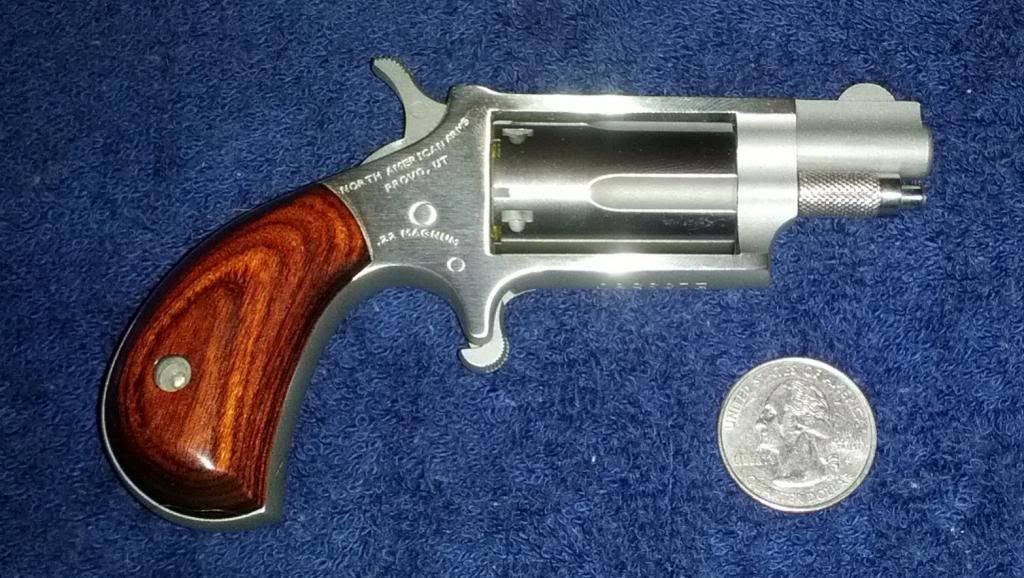
Pocket-sized personal protection

The Mini Magnum's cylinder must be removed in order to load and unload the firearm.  This is accomplished by pushing in a button on the end of the cylinder pin, then pulling the pin out of the front of the firearm.  Placing the firearm on half-cock, the cylinder may then be swung out for loading.  In unloading, the cylinder pin may be used to push out stubborn empty cases.  Once the cartridges are loaded, the cylinder is then replaced into the frame, the cylinder pin is replaced, and the gun is ready to fire.  Reloading this gun does take some time, and is not something that one would want to undertake in the heat of the moment.  You have five rounds:  make them count.

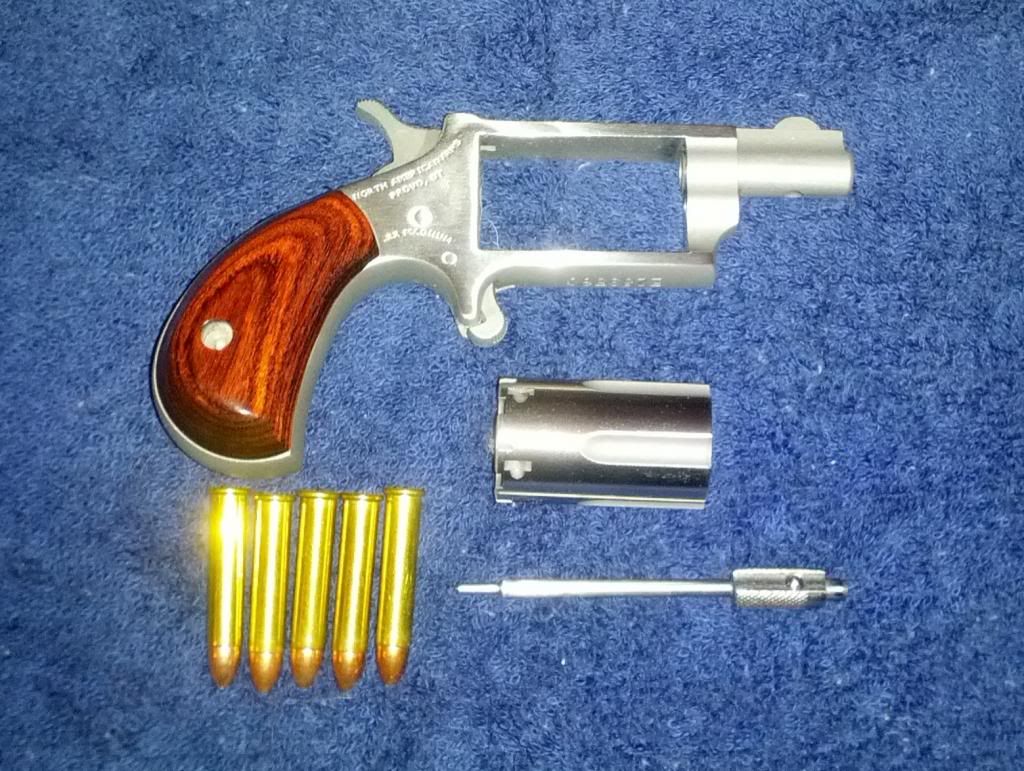
Shown with cylinder removed for loading.

Since the revolver does not have a hammer-block safety, one would normally only load four of the five chambers, so that the hammer may be rested on an empty chamber to alleviate the chance of accidental discharge.  North American Arms has developed an ingenious work-around for this, however.  Between each chamber, there is a shallow safety notch, in which the hammer may be rested, thus allowing the weapon to be carried fully loaded.
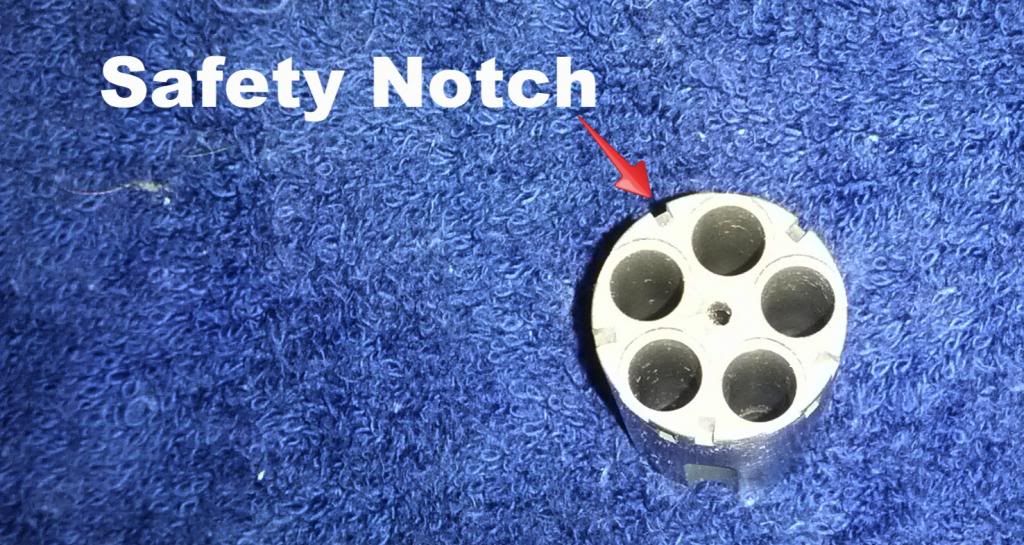
Cylinder removed, showing safety notch
 (and powder residue in the chambers)

Shooting the NAA Mini takes some getting used to.  For one thing, the grip is very small.  I can only get three fingers on the grip, with my pinky curled under it.  Also, the gun is single-action, requiring the hammer to be manually cocked before each shot.  I have found that I obtain the best results by using a two-handed grip, with my support-hand wrapped around my shooting hand, and using my support-hand thumb to cock the hammer, thus eliminating the need to change my grip with each shot.  The .22 Magnum, while a rimfire cartridge, is a powerful round.  Firing one out of a gun not much bigger than a Zippo lighter is, well...  exciting.  There is no painful recoil, but the entire gun tends to rotate barrel upward in your hand when it is fired.  With practice, one can learn how to control this tendency, however.  One thing I would stress is that hearing protection is a must when practicing with these revolvers:  the .22 Magnum absolutely roars out of this tiny little gun.

The NAA Mini is every bit as accurate as a revolver with a 1 1/8" barrel can be, once you learn how to shoot it.  I have found that using the front sight to aim results in shots being consistently below the point of aim.  Sighting along the top of the barrel, however, gives much better results.  Shooting slowly at a range of fifteen feet, I am able to get consistent three inch groups.  Rapid point shooting at the same distance, the groups open up, but I can still put all five shots inside of the 8-ring.  With more practice, I think I will be able to shrink that down to the 9-ring.

I do not pretend that the .22 Magnum is the best cartridge for self-defense.  However, I do believe that it is a serviceable round, and would certainly be capable of stopping a threat if one knows how to use it.  Nor do I think that a gun with a tiny barrel and rudimentary sights is the best option for a gunfight.  The NAA Mini Magnum is an up-close-and-personal "get off of me" gun...  what some people have called an "E.N.T." gun - short for ear, nose, and throat, meaning that the face, head, and throat would be likely areas to target with this type of weapon.  Thus, I will not be replacing my everyday carry gun with the NAA Mini Magnum.  However, I do believe that the Mini makes a great back-up gun to my S&W Model 60.  And on those occasions when I cannot carry "the Chief," at least I do not have to be completely unarmed.  The NAA Mini just gets popped into my front pocket, and I am ready to go.  In fact, since I purchased "Maggie," I have not left the house without her (so far I have been able to avoid the post office, courtrooms, and airplanes).  The Mini Magnum is one of the best ways to live the mantra:  always carry, never tell.
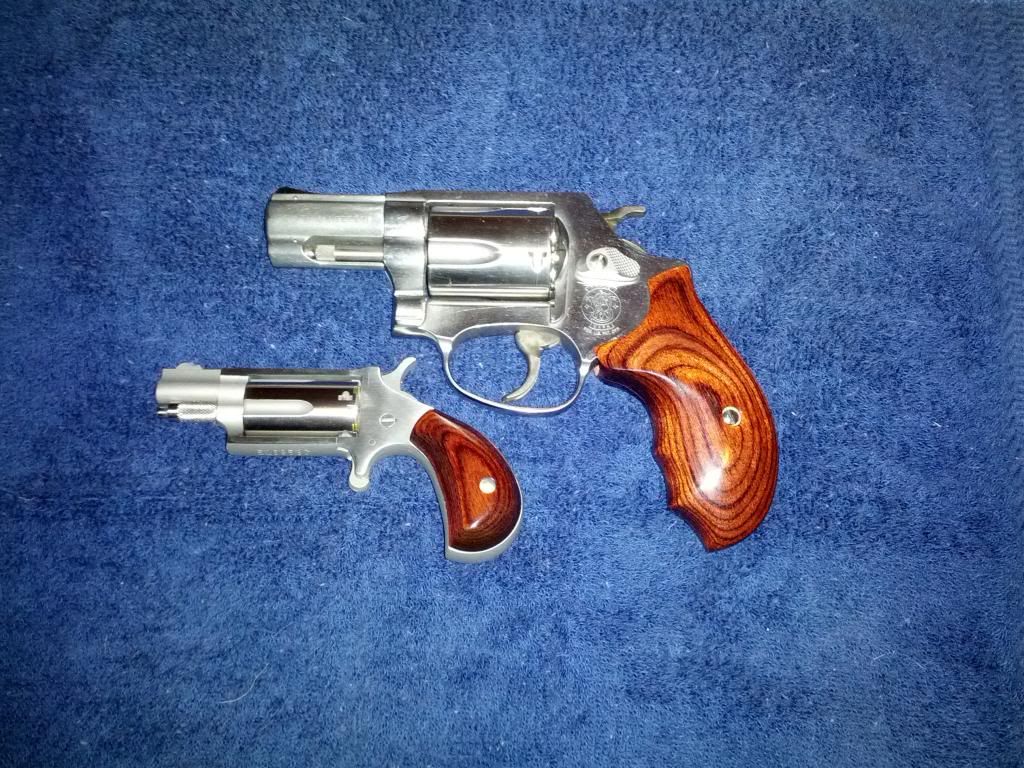
My (almost) matching pair of magnums:
S&W Model 60 .357 Magnum and NAA Mini Magnum


For more information:

North American Arms

Wednesday, August 8, 2012

Pint-sized Powerhouse: My Palmetto State / Doublestar 7.5" AR 15 Pistol Project

Addictions come in many flavors:  mine just happens to be gun collecting.  Firearms find their way into my collection for various reasons.  There are some guns that I desire due to their historical significance.  Others, I seek out because they are examples of fine workmanship, exceptional engineering, or both.  Still others have been selected due to their utility for self-defense, hunting, target shooting, etc. -  my "working guns," as it were.  And finally, there are what I consider my "fun guns":  firearms that I simply find entertaining - plinkers and the like.  And my newest acquisition falls into this last category.

I say "acquisition," but that is not technically accurate, as this particular firearm is one that I built from parts.  The first gun that I built completely from parts, actually... an AR 15 pistol.  This particular build has been in the works for quite a while:  I have been picking up pieces here and there for nearly a year. There seemed to be no rush to complete it as I originally conceived of this gun simply as an exercise in "kitchen table" gunsmithing.  However, as recent events have thrust the possibility of new gun control legislation into the spotlight, and with this being an election year, I decided that I should go ahead and finish this gun while I still had the opportunity.

AR-style pistols are nothing new, and you will find them in several different calibers.  For this project, I decided to stick with the traditional 5.56mm chambering, even though you will find many detractors who ridicule the use of this rifle cartridge in such a short barrel.  And to be honest, their arguments are not without some merit.  The 5.56mm cartridge was originally designed to be used in a rifle with a barrel 20 inches in length.  Any less than this length reduces the efficacy of the cartridge.  Now, it seems the majority of AR models on the market today are based on the 16 inch carbine barrel, a length that generally produces adequate ballistics.  As you decrease the length of the barrel, however, not only do you rapidly lose velocity (and hence energy), you also decrease the reliability of the weapon:  the AR direct impingement gas system does not operate as smoothly when it is shortened.  The short barrel does not allow the pressure in the gas tube enough time to act on the bolt in the same manner it would in a longer barrel.  The trick to getting an AR pistol to run reliably requires experimenting with springs, buffer weights, etc.  Thus, the loss of energy (affecting fragmentation of projectiles in the target) and potential loss of reliability are factors that must be considered.

After weighing my options, I decided to stick with 5.56mm for two main reasons:  first, if I am going to have an AR, I want it to be in that caliber, as that makes it compatible with my other AR, and thus parts and accessories can be shared; and second, it allows me the option of running a .22LR conversion kit, thus making this a much more affordable range gun.  And if, God forbid, I should ever have to use this gun in a defense role (it would probably fall way down the list of my options), it would still have enough "oomph" to get the job done.

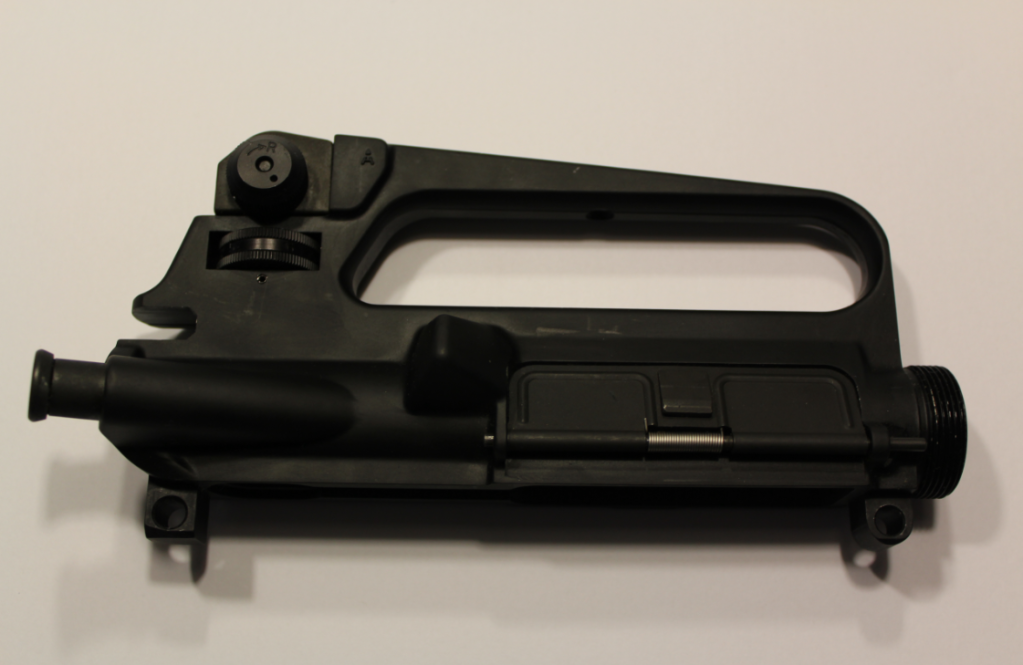
This build started with an A2 upper that I happened to have lying around, waiting to be assembled.  I really like the look of the A2, with the built-in carry handle...  it is to my mind what an AR-15 should look like (one man's opinion, true, but hey, this is my gun we are talking about).

A2 upper receiver
(image courtesy of ar15.com)
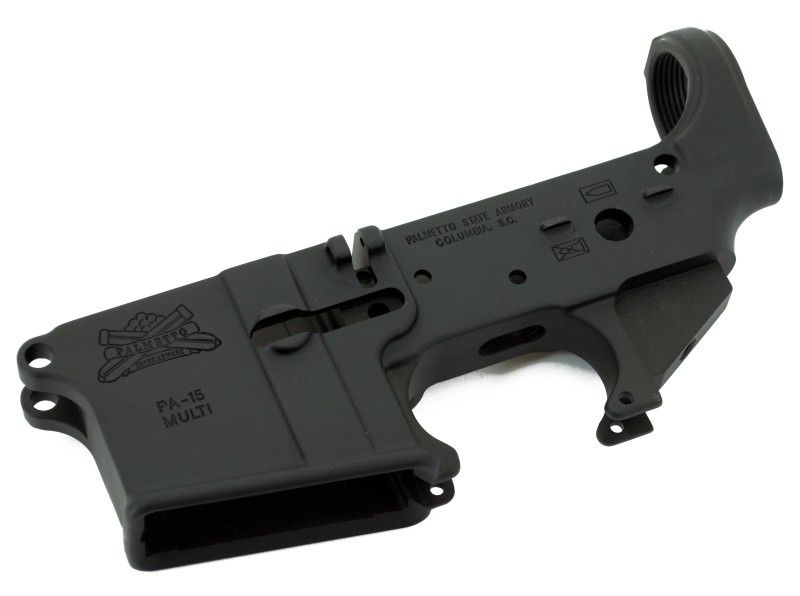
For a lower receiver, I bought a stripped lower from Palmetto State Armory.  Occasionally, you can get a great bargain on these lowers, and I bought mine on sale for $49.99 last Valentine's Day.  A fantastic deal on a fantastic lower.  Note:  when building an AR pistol, it is extremely important that you use either a lower designated as a pistol lower, or a "virgin" lower that has never been assembled as a rifle.  If the lower has ever had a buttstock attached, (even if it is clearly labled "pistol" on the receiver) you may not use it to build a pistol without running afoul of the NFA regulations.  You should always check to make sure that the lower was transferred to you as "pistol" or, (preferably) "other," not "rifle," before using it for a pistol build.

PSA Stripped Lower Receiver
(image courtesy of palmettostatearmory.com)
This being a stripped lower, I required a lower parts kit to finish it.  I decided to go with the DPMS kit, as I had heard good things about them, so this I picked up from Tri-Cities Gun Depot.

DPMS Lower Parts Kit
(image courtesy of surplusammo.com)
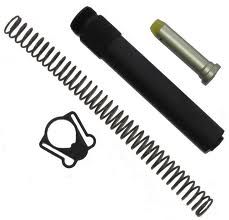
As I was assembling a pistol, I decided to go with the Doublestar Arms carbine-length pistol buffer tube.  The research I had done indicated that the longer buffer tube and spring was less prone to malfunction and required less fine-tuning to operate reliably.  This I picked up from another local gunshop, Gunslingers, in Kingsport, TN (a fantastic place for AR fans...  they have just about anything you could need or want).  I also swapped out the standard pistol buffer for an H2 buffer, as the data seems to show that 7.5" pistols run more smoothly with the heavier buffer.

Doublestar Arms Pistol Buffer Kit
(image courtesy of jsesurplus.com)
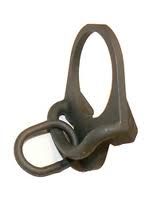
I also decided to go with the Magpul ASAP ambidextrous single-point sling adapter, which I picked up at Tri-Cities Gun Depot, as well.  I like how it allows the sling to move freely to either side of the weapon.

Magpul ASAP
(courtesy of del-ton.com)
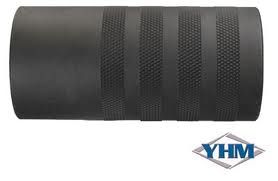
To finish the upper, I ordered a pistol-length gas tube with roll pin, and a Yankee Hill Manufacturing Mini Free Float Tube Forearm from JSE Surplus.  Since I would not be adding a vertical fore grip (another NFA no-no), I decided against a railed handguard, and instead went with the more rounded tube from YHM, which is also very light-weight as well.

YHM Mini Free Float Tube Forearm
(image courtesy of galatiinternational.com)
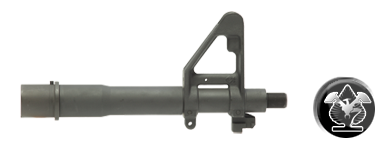
For a barrel, I again chose Doublestar Arms, and ordered the 7.5" Heavy Profile Barrel with Forged Sight Base from J&T Distributing.  It did not come with a barrel nut (almost all 7.5" ARs are fitted with free float tubes... in fact, I do not know where you would find a standard 2-piece handguard that short), but has M4 feed-ramps, and you can choose to have it chrome-lined for an additional cost (I went without chrome-lining...  just a personal preference).

Doublestar Arms 7.5" AR Pistol Barrel
(image courtesy of jtdistributing.net)
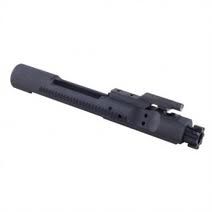
One reason I went with the Doublestar barrel is that I had also picked up a Doublestar bolt carrier group and charging handle at Gunslingers.  I know that most reputable manufacturers turn out parts that meet the industry standard for specs, but I always like to get a barrel and BCG from the same company when I can.  Sticking with the "evil black gun" look, I chose the phosphated BCG, rather than a chrome group.

Doublestar Arms Bolt Carrier Group
(image courtesy of tacticalar15s.com)
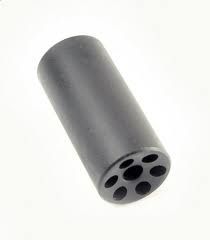
And to finish it out, I decided to go with the Levang Linear Compensator as my muzzle device.  I have read a lot of good stuff about this comp from other pistol builders.  One of the issues with the AR15 pistol is that there is a LOT of unburned powder that makes it out the end of that short barrel, resulting in a tremendous muzzle flash, and the noise and concussive force produced by firing the gun can be overwhelming.  The Levang Linear Comp addresses this by directing this gas, noise, and force forward away from the shooter, thus making the gun more shootable.

Levang Linear Compensator
(courtesy of parallaxtactical.com)
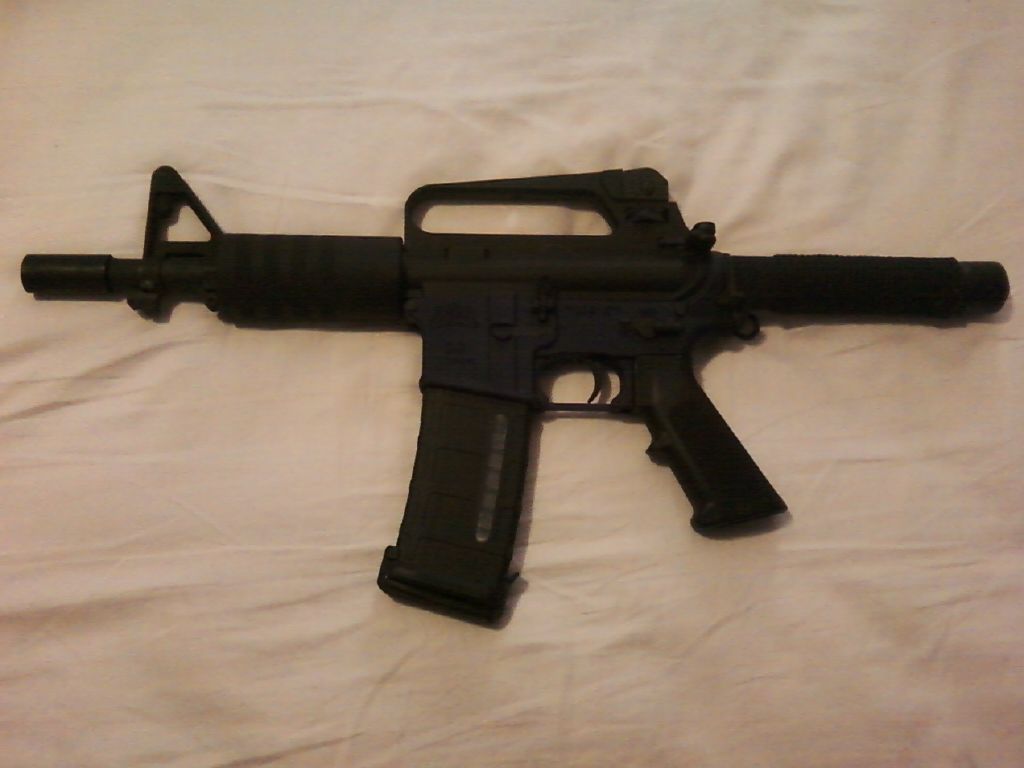
Put all of these parts together, paracord wrap the pistol buffer tube for added comfort when getting a cheek-weld, throw in a Magpul 30 round P-mag,  and the end result is one pint-sized powerhouse - the AR15 pistol.

Say "Hello" to my little friend!!
I will update this post when I have a chance to get it out and shoot it.  Not looking for any sub-MOA groups with this little one, but I imagine it will be a BLAST at the range!!  And if there are any other AR pistol enthusiasts out there, tell me about your builds...  I would love to find out what your setups are.

Oh, and one final thought:  to all of the gun forum sages out there who are so quick to denigrate the AR pistol, the .500 S&W, the Barrett .50 caliber rifle, or any other firearm, as impractical, useless, excessive, or unnecessary...  these are the same arguments that those who would take away all of our guns have been using for years.  Let us not give these people any more ammunition by turning on one another.  Do I have a need for a .50 caliber Barrett?  No.  I would love to have one for the collection, but it will probably never happen for me (no offense, Ronnie...  you make wonderful guns, but I cannot afford to feed one).  But that does not mean that they should no longer be available to those who would have one.  Just like a two-seater convertible - practicality is not the end-all-be-all.  The Second Amendment says "shall not be infringed," so let us try our best to keep it that way.

Friday, May 25, 2012

Gun Review: Rossi Model 25 Princess .22LR Revolver

As a gun collector, I am constantly on the lookout for interesting, unusual, and uncommon pieces.  Now, do not get me wrong, I enjoy shooting, and therefor I put a premium on reliability and accuracy, but I also very much am interested in the history of guns as well, and I love firearms that are more than just your run-of-the-mill, everyone-has-one models.  Such as my Remington 878 Automaster, which I covered in a previous post...  it may not be worth a great deal in monetary value, but to me, it is valuable as a piece of Remington history, and thus of firearms history.  The same can be said of my military surplus rifles:  somewhere, sometime, someone trusted his life - and possibly his nation's survival - on these rifles.  Each arsenal repair, each little ding in the wood stocks, is part of a story, and I find that fascinating.
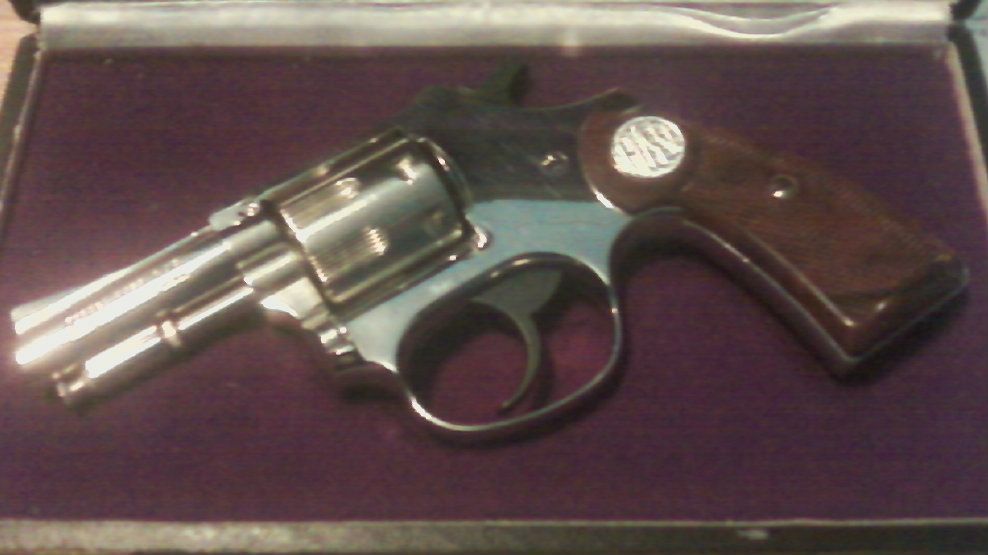
The Model 25 presentation case

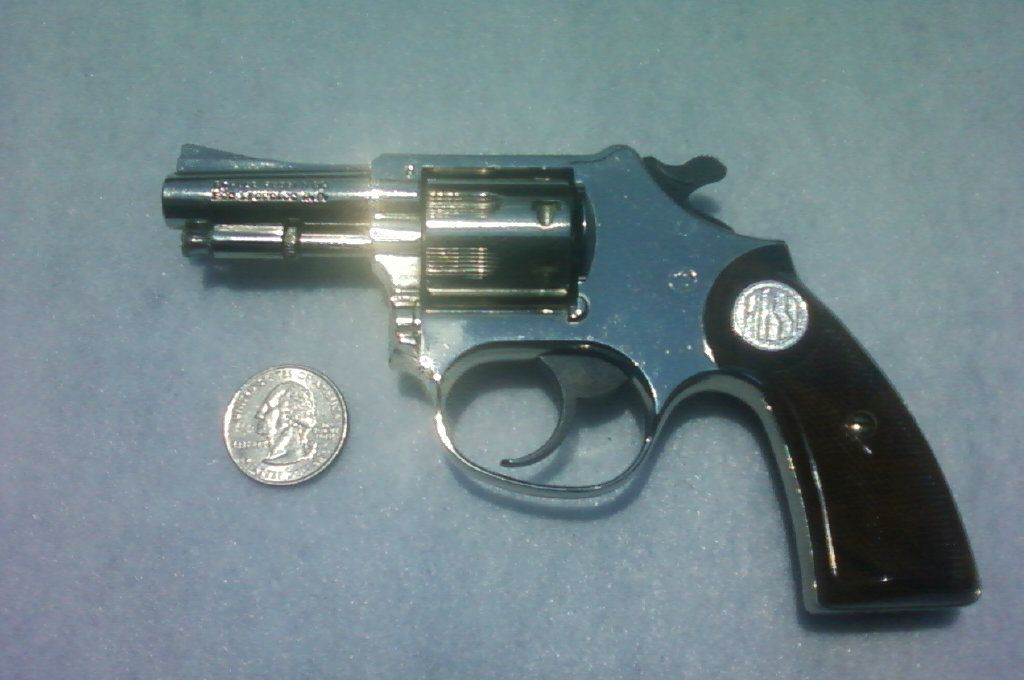
Recently, I came into possession of another little piece of history.  And I do mean little.  It is the Rossi Model 25, a petite revolver chambered in .22LR.  Known as the "Princess," this tiny little pistol is quite beautiful with its bright nickel-finish.  The left side of the barrel is stamped "AMADEO ROSSI & CIA/SAO LAOPOLDO R.S." while the right sideplate is stamped "MADE IN BRAZIL" with the Rossi trademark and the importer marking "FIREARMS INT'L CORP/WASHINGTON, D.C."  The right side of the barrel is stamped ".22 L.R."  The serial number is stamped on the frame below the grip.

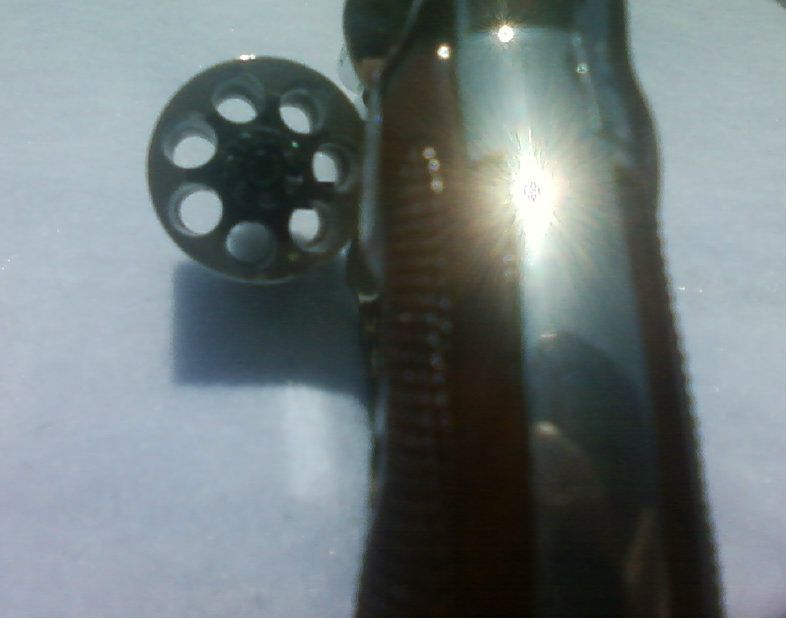
Just barely six and a half inches long, with a barrel length of two inches, the Princess is smaller than a grown man's hand (a 3-inch barrel version was also manufactured, designated the Model 13).  Despite its diminutive size, however, the Model 25 has a swing-out seven-shot cylinder with a manual ejector rod.  It is a single-action / double-action revolver, and while the trigger is quite stiff (I would estimate it at around fifteen pounds), it is smooth with no slop.  The brown plastic grips have some black marbling throughout, and they sport a round medallion (a la S&W) bearing the Rossi logo.  Actually, these are some of the nicer grips I have seen on Rossi revolvers.  The grip is very short, and leaves little room for a big hand...  this gun was definitely made with ladies in mind.


The Rossi Princess
Shown with a quarter for perspective

The frames of the Princess revolvers are die-cast of Zamak (or Zamac), sometimes disparagingly referred to as "pot metal."  Zamak is a zinc-aluminum-magnesium-copper alloy, which is actually quite strong, certainly for the frame of a .22LR revolver (Hi-Point Firearms uses Zamak for the slides on their centerfire pistols and carbines).  This results in quite a light weight pistol.


The Rossi Model 25 is a copy of the third model Smith & Wesson "Ladysmith," an M-frame revolver manufactured during the first two decades of the 20th century. The M-frame was the smallest hand-ejector frame made, and was used for the .22 Long, and was discontinued in the early 1920s.  Rossi, a Brazilian gun manufacturer (now a member of the Taurus family of firearms companies), resurrected this revolver concept, manufacturing the Model 25 for 28 years from the 50s through the mid-80s, with nearly a million of the little revolvers sold.  However, because of U.S. gun laws, primarily the 1968 Gun Control Act, relatively few Model 25s were imported into this country, all of them between the years 1965 through 1969.  It is getting more difficult to find these guns, especially in good condition.

Surprising amount of firepower for such a diminutive gun
Rossi, like its parent corporation Taurus, has a lot of detractors and, to be quite honest, not without good reason.  For a period of time during the 1980s, both companies suffered from poor quality control, turning out a large number of guns that had problems.  It does not take long for such inattention to sour consumers to a product line, especially when the primary purpose for many of these products is personal defense.  However, the early guns manufactured by both Rossi and Taurus were of quite good quality (and I understand that both companies are doing much better recently, trying to address the QC issues).  The Princess is just such a gun.  The internal parts are well-made, the cylinder lock-up is tight with no play.  The timing on the cylinder is spot-on as well, with no chamber misalignment.  It is simply a nice, tight little revolver, especially when it is compared to a lot of the other inexpensive revolvers that were being imported around the same time (Rohms, for example, which were notorious for being poor-quality).  Not too shabby for a gun that originally sold new for between $35 and $40 at your local Ace Hardware (recently these revolvers have sold for as much as $250 - $350 on GunBroker and other sites...  I call that a good return on an investment!).

One thing I have noticed, however, is that when shooting .22LR cartridges, you can get a bit of powder-flash coming from between the cylinder and the forcing cone (no lead shavings like that old Rohm used to shower me with, though).  This does not happen with .22 Shorts or .22 Longs, and I have to wonder if it is due to the newer hypervelocity .22LR cartridges being so much more powerful than the .22LR cartridges of the mid-Sixties.  I will try some sub-sonic loads soon to see if that makes a difference.  Accuracy with various loads has been quite good for a short barreled revolver.  This one is definitely a keeper.

If you have a Rossi Model 13 or 25, and have any more information on this gun, please leave a comment below.  Let me know what ammunition your Princess likes, and how well it is holding up.  There is not a lot out there on these revolvers (thanks to Ed Buffaloe at unblinkingeye.com for a great write-up, and the various gun fora from which I have gleaned some nuggets of wisdom), so anything you might have to add would be appreciated.

For more information on Rossi:

http://www.rossiusa.com/

Friday, May 18, 2012

Gun Review: Metro Arms American Classic Commander 1911 .45ACP

For those of you who have been following this blog, you know that back in March of last year, I posted a review of the Metro Arms American Classic II 1911, which at the time I gave high marks.  More than a year later, my opinion of this pistol has not changed.  It continues to perform flawlessly (after having changed out the magazine catch, which I described in a post in June of 2011), and I am well pleased with this firearm.  Pleased enough, in fact, to purchase another Metro Arms 1911...  this time, the American Classic Commander.

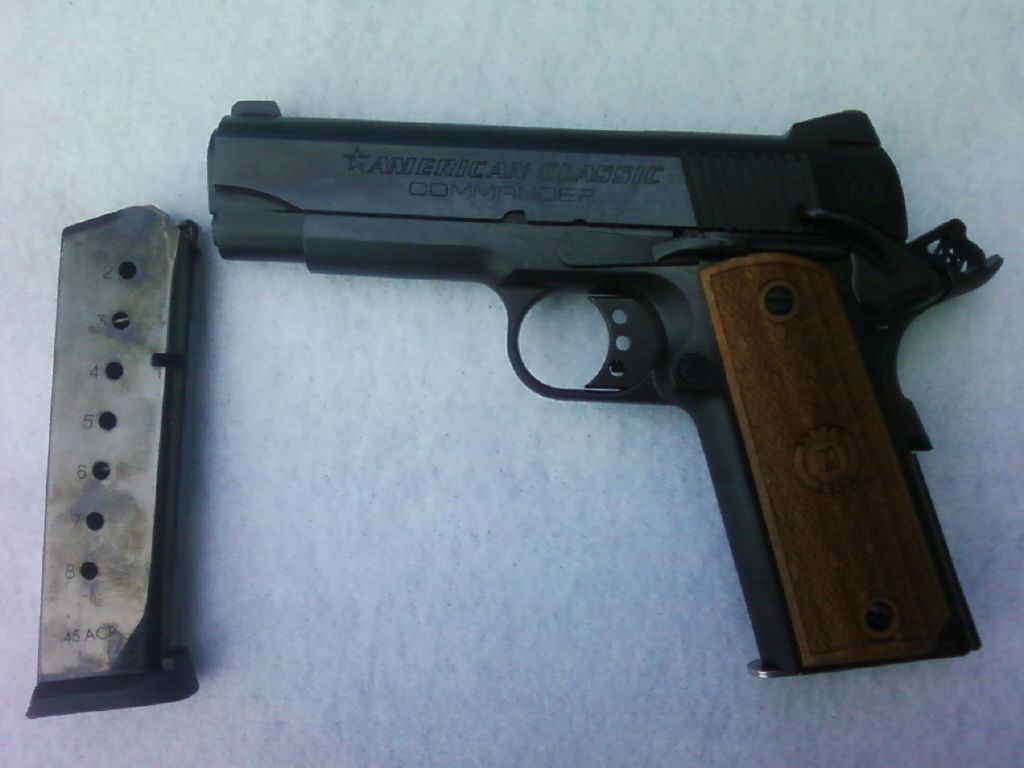
Metro Arms American Classic Commander


As you may well know, the Commander is a somewhat shorter version of the American Classic II.  The latter is a full-sized, or ""government," model, having a full 5-inch barrel with an overall length of 8.375 inches, and weighing in at 37.28 ounces empty.  The Commander has a slightly shorter 4.25 inch barrel for an overall length of 7.5 inches, and a weight of 35.2 ounces.  Not a whole lot of difference.  In fact, the two models use the same magazines interchangeably.  Both have the same grip length, and the controls are placed in the same locations on the pistols, so muscle memory is not affected by switching from one pistol to the other the way it would be with a similar gun with a smaller form factor (like a compact 1911, or a Sig P238, for example).

The particular American Classic Commander that I chose was the deep blue model, which I purchased from my favorite local gun shop, Tri-Cities Gun Depot.  Unlike the ACII, which is the hard chrome model, my Commander has a rich, dark blued finish.  The bluing seems very even, without any noticeably light spots.  One thing I have noticed, though, since I have had the pistol, and something that has been mentioned on the firearms fora I frequent, is that manipulating the thumb safety has left some scratches in the bluing under the safety, as though there might be a burr or rough spot on the underside of the safety lever.  There was also a very light scratch under the slide-release when I first disassembled the pistol (the proverbial "idiot scratch"), I am assuming from the factory.  Neither of these are deal-breakers for me, especially considering this is going to be a carry gun (provided it meets my reliability requirements) and therefor will be subject to much wear, but I would have preferred a little better QC on this front.

Shown with 8-round ACT mag, 7-round flush fit mag not included


For the most part, this particular pistol seems as well-made as the Classic II.  All of the parts seem well-fitted.  Like the ACII, this model comes with the extended slide-stop, extended magazine release, full beavertail, and extended thumb safety.  The grip safety is a bit more loosely fitted than that of the ACII, but it is not loose enough that it rattles.  The thumb safety engages positively, the trigger is smooth and has very little take-up (it is fitted with an over-travel adjustment screw, too), and the magazine catch engages easily and releases the magazines freely.  The slide to frame fit is also very tight, but not so tight that it drags and causes feeding issues.  Also, like the ACII, the wood grip panels that come with the Commander are nothing to write home about.  Functional, but not fancy.  One thing I will point out is that should you desire to change the grips, the oversized controls may necessitate some minor alteration of the replacement grip panels to allow them to fit without interfering with the operation of the thumb safety and slide release.

Thus far, using four different magazines, I have fired one hundred seventy rounds through the Commander, and I have had one failure during that time.  The ACT magazine that comes with the Commander is the same 8-round mag that is sold with the Classic II, and I had no issues using that magazine.  Likewise, my Springfield, Colt, and Kimber 7-round magazines have thus far been flawless with this pistol.  The one failure to feed that I have experienced has been with a flush-fit 8-round Triple K magazine, and that was with the second round during the first time I used that particular magazine.  Subsequent uses did not result in similar failures, so I am chalking that one up to magazine break-in.  I have only fired 100 rounds of Blazer Brass and 50 rounds of PMC Bronze 230 gr. FMJ rounds, and 20 rounds of Hornady Custom 185 gr. XTP JHP through the pistol at this time (the single FTF was with the ball ammo).  Thus far, it looks as though the factory magazine catch is working well, so perhaps Metro Arms has addressed that particular issue.

Accuracy has been very good.  Out of the box, my point of impact was about four inches to the left at 50 yards, consistently.  The Commander, like the ACII, has adjustable 3-dot Novak-type sights, so this was easily and quickly remedied.  Recoil is stronger than with the 5" model, enough that it is noticeable, but still not enough to be uncomfortable.  These pistols are just a lot of fun to shoot.

I have been well-pleased with the Metro Arms Commander up to this point.  I will continue to post updates if anything changes, but it looks as though this company is continuing to manufacture and market an excellent line of firearms.  And at an excellent price point...  this particular gun is in the sub-$500 range, but runs like a top of the line model.  I think JMB would be happy.

Monday, June 6, 2011

MetroArms American Classic II -- EGW magazine catch and Pearce grip insert review

This episode of Shooting from the Hip is a follow-up to my review of the MetroArms American Classic II model 1911 pistol.  Specifically, I recently completed my first two upgrades, and I wanted to share with you what I changed, as well as why I did so.

Now, you may be asking yourself why, if I like the ACII so much, I felt the need to change something.  Well, for one thing, it is a 1911, after all, and one of the beautiful things about this pistol is that it is a platform that begs one to customize it to one's own preferences.  From grips, to sights, to triggers, hammers, even guide-rods, there isn't much on the 1911 that cannot be tweaked to fit the individual shooter.  In this particular case, my first upgrade was to add a Pearce rubber grip insert.


(Image courtesy of pearcegrip.com)  Now, while I am a big fan of wood grips on a 1911, the slim aspect of the 1911 doesn't fill my hand very well.  I have big hands, and I am used to double-stack guns that are wide enough to fit my hand well.  Part of the attraction of the 1911 though is the slimness, making it a good carry pistol, easy to conceal, so I did not want to lose that aspect.  My choice, therefor, was to try the Pearce grip insert:  a rubber insert that adds finger grooves to the frontstrap, while not greatly altering the thickness of the grip itself, and still allowing the use of the wood stocks.  Installation could not be simpler:  simply unscrew the grips, put the grip insert on aligning the precut holes over the grip screw bushings, then replace the grips.  The insert is cut generously, leaving some trimming to be done, but an X-acto knife makes quick work of that.

Range time with the new grip definitely showed a difference in the handling of the pistol.  The rubber grip afforded me a firmer grasp on the firearm, and it seemed to point more naturally.  Whereas before I installed the Pearce grip, recoil would occasionally cause the pistol to shift in my hand, I found that this was no longer the case with the new finger grooves.  Speed and accuracy of follow-up shots increased perceptibly.  I am curious as to whether the grip will prove to be durable, since the rubber under the stocks is rather thin (by design, of course), but time will tell.

The second modification I made to my ACII was to install a new magazine catch.  The one issue I have had with the pistol is that on a couple of occasions, it has failed to chamber a round when I have manually racked the slide.  I have not had this issue when using the slide release, only when "slingshotting" the slide.  This issue has been mentioned on a couple of firearms forums, as well.  It seems that the magazine catch on the ACII may be a bit low, allowing the magazine to sit a fraction of an inch lower in the magwell than normal.  This causes the top round in the magazine to have a bit of a higher jump to make it into the chamber.  Not much of an issue with round ball, but it can cause hollowpoints to jam.  As I intend to use this gun for home defense and possibly self-defense, it must reliably cycle hollowpoints.

One solution to this problem that I discovered on the M1911 forum (a great place to find information about this amazing weapon platform) was to change out the factory mag catch with a replacement that is machined to hold the magazine higher in the magwell.  One such product is manufactured by the company EGW, or Evolution Gun Works.  The HD Higher Mag Catch is available in either blued or stainless, is milled from solid 4140 Chromoly steel, and is designed to hold the magazine .020 inches higher than a standard mag catch.

While the company states that the part should fit "in most good quality 1911s," like any other "drop-in" 1911 part, some fitting is often required.  This was the case with the ACII:  a couple of minutes of light grinding and buffing, and the catch fit perfectly.  And it works as advertised.  The factory catch allowed the magazines to sit just a fraction of an inch lower in the magwell, and I could hold up on the bottom of the magazine and it would move ever-so-slightly up.  With the EGW catch, the magazine base is flush with the bottom of the magwell -- a nice, tight fit, holding the top round in a more direct line with the chamber.  Hand racking the slide several times with three different magazines showed that the rounds fed much easier into battery.  Pressing the EGW catch still allows the empty magazines to fall away freely, as well, so there should be no issue with tactical magazine changes.

After another 50 rounds (Federal 230 gr. FMJ) through it today, with no failures of any kind, the American Classic II by MetroArms continues to impress me.  It is definitely worth looking at if you are interested in a 1911.  I would also recommend looking at what EGW has to offer, with respect to aftermarket 1911 parts.  The website is easy to navigate, ordering was simple, and delivery was fast.  Three things I look for in an online seller.  You might also check out what Pearce has to offer, not only for the 1911, but for a variety of other pistols as well.

Monday, May 23, 2011

Metro Arms American Classic II -- First Shooting Video

Had a few free minutes today, so I thought I would take a quick little video of some range time with my Metro Arms American Classic II.  Not the best shooting, and not the best video, but I am working on both.  All told, I put another fifty rounds through my ACII today, all Remington 230 grain JHPs, without a single failure of any kind.  Here are the last four magazines worth -- 8 rounds in the ACT magazine that comes with the pistol, 7 rounds in my Springfield magazine, 7 rounds in my Kimber magazine, and the last six shots were also in the Springfield mag.  At a distance of about 15 yards.


(Note:  The shots on the left hand target are from an earlier session with my wife shooting her Ruger LCR.)

The more I shoot this ACII, the more I like it.  The action is tight, yet slick, and seems to be getting better the more I shoot it.  Absolutely no problems at all with the jacketed hollow points, even cheap Remington bulk box rounds.  I would like stocks with a little more "grip," as the factory stocks are a little smooth for my taste, so that may be my first real customization.  Still, it is a great gun for a great price.  I cannot wait for the Amigo to make its way to my locale, as I am really looking forward to getting my hands on one.

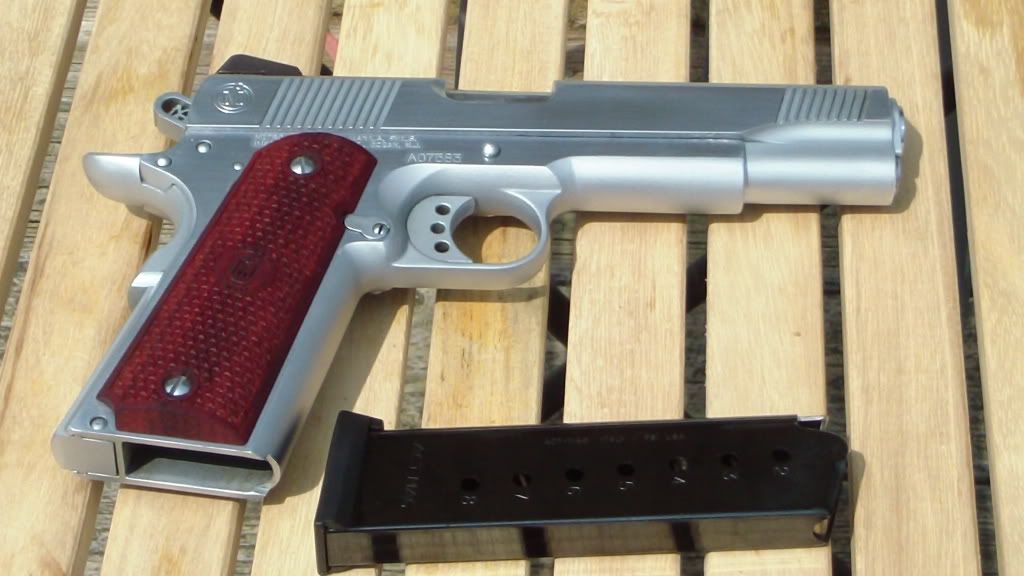
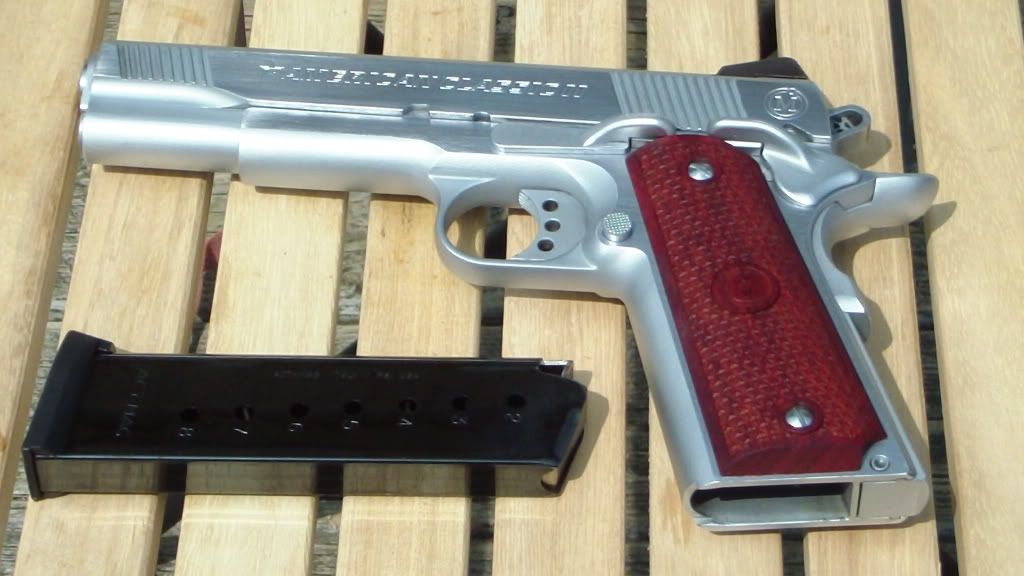
Thought I would throw in a couple of pictures of the hard chrome ACII:

Thursday, March 24, 2011

On the Edge: Rimfire Review of the Heritage Rough Rider .22LR / .22 WMR

For tonight's edition of SFTH, I have decided to try something new.  This will be the first in a periodic series of columns in which I give my reviews on rimfire guns, ammunition, and accessories.  I am entitling this series "On the Edge," so if you see that in the title, you will know what to expect.  I believe that rimfire enthusiasts are often overlooked in a lot of gun review sites, so hopefully I will be able to share my thoughts and experiences with you, and through your comments, you can share your own insights with myself and our other readers.

For my first On the Edge review, I have decided to cover my favorite rimfire gun:  the Heritage Rough Rider single action revolver.  And if you look at the GunTotingVigilante avatar, you will see this fine pistol which has become my favorite firearm to shoot.  When I go to the range, this gun almost always accompanies me.  Why?  Because it is accurate, inexpensive to shoot, and, if for no other reason, it is just plain FUN!

A little history lesson first.  Heritage Manufacturing operates out of Opa Locka, Florida.  It is an American owned and operated company in the business of providing fine firearms at relatively low cost to consumers all across our country.  Heritage manufactures its rimfire line of pistols, the Rough Riders, here in the States.  A line of big bore single action revolvers is also produced, but these are made from parts manufactured in Italy, then imported and assembled at the Florida plant.

The Rough Rider revolvers are available in both .22 LR (which also allows the use of .22 CB,.22 Short, and .22 Long) as well as .22 WMR, and some, like mine, come with both cylinders which can be swapped out in a matter of seconds by simply pushing in the cylinder-pin release, pulling the pin out, lifting out the cylinder, and replacing it with the new cylinder, then re-inserting the cylinder-pin.  Barrel lengths vary from 3.5" up to a full 9".  There are two types of frames available for these guns:  where it is allowed by State law, you can get a RR with an alloy frame, and in other states (HI, SC, IL, and MN) a steel frame is available.  The alloy frame is certainly strong enough for the low-power of the rimfire rounds, and it reduces costs, making these pistols some of the most affordable revolvers on the market, under $200 in many places, depending on model (I paid $180 for mine, a blued finish, pearl handled, 6.5" barrel LR/ WMR combo gun).

A variety of finishes is available, with a traditional blue (which I opted for), a case-hardened finish, a black satin, and a silver satin finish.  Purchasers also have a decent selection of grips to choose from, including colored laminated wood grips, Cocobolo grips, synthetic pearl finishes (mine wears the white pearl grips...  yeah, call me a New Orleans pimp), as well as synthetic ivory stocks.  Some of the Rough Riders come with old fashioned fixed sights which consist of a front blade and a grooved top-strap for the rear sight, while others have adjustable sights.  And every Heritage Rough Rider comes with a hammer-block manual safety, an unusual addition to a single action revolver, and one that takes getting used to (I feel that it is unnecessary, but as a former attorney, I understand why the company has opted to include it).

Ok, sure...  but how does it shoot?  Thought you would never ask.  As of the posting of this column, I have fired approximately 1250 rounds of .22LR, 50 rounds of .22 Super Colibri, and 70 rounds of .22 WMR through my Rough Rider.  I have never had a single malfunction, apart from having ammunition which failed to fire or squibbed (look for my upcoming review of Remington Thunderbolt ammunition).  Even when fanning back the hammer and firing as fast as I can, the timing and cylinder lock-up has always been right on.  While I have heard from other owners that have had to tweak their front sight blades to achieve accuracy, mine was dead on right out of the box.  One of my favorite skill tests is to line up shotgun shells at 10 and 15 yards and plink at them with this pistol.  And this gun is more than capable of making them dance, even at those ranges.  I have found that the gun seems to be a bit more accurate with LR rounds than with WMR, which is counter-intuitive to me, but seems to be borne out by the performance of the gun.

After all of those rounds, and the cleanings, and the holstering and unholstering, the finish still seems to be holding up very well, with just a little darkening on the frame around the forcing cone, but a lot of rimfire ammunition is notoriously dirty, and I imagine that has a lot to do with that.  The trigger is not the best in the world (not compared to, say, my dad's old Ruger Single Six, for example), but it seems to have improved with use.

All-in-all, this has been one of my best purchases.  I use this gun on a regular basis, and do not see that changing any time soon.  Maybe I am just living out my childhood cowboy fantasies (which will also be addressed in my upcoming review of the Henry Golden Boy), but there are few firearms that I enjoy shooting as much as this little revolver.  Is it destined to be a family heirloom?  Not at all.  But I would not be surprised if my Heritage Rough Rider is still being used by future generations of GunTotingVigilantes in the years to come.

For more information, go to http://www.heritagemfg.com .

Gun Review: Metro Arms American Classic II 1911

It has been a while since I have added to Shooting from the Hip, but I am happy to be back and share another review with you.  I am especially happy to share this particular review, since it is about my most recent firearm purchase. And what a firearm it is, too.

As many of you are certainly aware, this year marks the centennial anniversary of the adoption by the United States' military of the m1911 Colt Automatic Pistol, what many consider John Moses Browning's finest creation. I happen to be one of that particular group.  I, and many others, feel that while this particular design may be one hundred years old, it is still a viable side-arm, with perhaps the finest trigger of any automatic pistol ever designed.  And as I have never personally owned a 1911, I decided that this year would be the year to remedy that particular deficiency.

So, a couple of weeks ago, I went by my favorite gun shop, Tri-Cities Gun Depot (see my previous post for a review of this fantastic shop) to see what 1911s they had in stock.  And they had several.  There was, of course, a Centennial Colt; a beautiful Kimber; a new Remington (very glad to see them return to the 1911 game); a few Rock Island Armory pieces (very well-made Philippine guns, and very affordable, too); and one with which I was unfamiliar:  the Metro Arms American Classic series, another Philippine gun.  The particular model I was looking at was a very well-made pistol, a full-sized Government model with the 5" barrel.  But there were some additions to this gun that you do not normally see on a stock pistol:  a full beavertail grip safety, combat hammer, light-weight trigger with overtravel adjustment, three-dot Novak-style sights, extended magazine release, extended slide release, and extended thumb safety to boot.  These guns have a nice blued finish, as well, rather than the Parkerized finish you see on many guns these days.  And most importantly, the fit and finish on the guns I looked at were exceptional for a gun in this price range (sub-$500).  The slide-to-frame fit, especially, was as good as a number of high-dollar guns I had looked at.

Faced with this unexpected choice, I decided to do some homework, and I searched the internet looking for information on these guns.  To be honest, there is not a great deal, but I was able to find some reviews on a few gun forums (or fora, to those guys and girls I had Latin classes with), and for the most part, every review was positive.  One thing that was brought up a few times is the fact that these guns include several MIM parts, but I discount this as a detraction since many "premier" gunmakers, such as Springfield and Kimber, include such parts as well.  I did find that the slide and barrel are forged, which was an added bonus in my estimation.

So, having just about decided to make the American Classic II my newest addition, Tom at TCGD had to throw me another curve.  He asked if I had seen the hard chrome version.  I had not.  To be perfectly honest, I am not much of a shiny gun kind of guy.  I like black guns.  They look like they mean business.  You don't see fingerprints on them.  They look like tools, not accessories.  But as part of my research, I looked up pictures of the chrome version...  and I was impressed.  Impressed enough to want to see one in person.  Now for the problem:  the Gun Depot didn't have a chrome gun, and didn't know when they would be getting one.  Hard to come by apparently, this shiny gun.  Well, I could wait, right?  Right...

As luck would have it, I did not need to wait.  Tom got one in the next week.  And it was love at first sight.  This gun looks even better in person.  The finish was excellent.  The checkered wood grips, while not superb, are much nicer than those on the blued version.  The fit was every bit as tight as on the ones I had previously fondled, er, I mean held.  And the trigger was sweet, breaking at around 4 lbs, I estimate.  Not much more than on the Colt Tom had in the case.  And I knew that it had to be mine.  And following a transfer of currency (the hard chrome is about $100 more than the blued version) and a nod from the TBI, it was indeed mine.

At home, a quick wipe-down and run a patch through the barrel to clear the packing grease and I proceeded to send fifty rounds of PMC Bronze 230 grain FMJ downrange without a single failure of any kind.  As quickly as I could load the single magazine, I would then empty it nearly as quickly.  And the accuracy of this gun is noteworthy.  Recoil is almost negligible (the gun does weigh over 30 ounces).  At thirty yards, all fifty rounds fell within a 6 inch circle, and this shooting standing free-hand about as quickly as I could pull the trigger.  Very nice.  I will update when I am able to get out again and shoot from the bench for groups.

All-in-all, I am very pleased with the ACII.  I feel that it is a lot of gun for the money, and it just goes to show that you do not need to drop a couple of grand on a custom build in order to get a quality firearm.  Since the ACII is full milspec, however, you can feel free to upgrade whatever you want, should you feel the need.  I would recommend to anyone who is looking to celebrate the year of the Colt with a new 1911, stop by Tri-Cities Gun Depot, or your nearest gun shop, and check out the Metro Arms offerings.  I think you will be impressed.

UPDATE:  I recently posted a new entry on the ACII and a couple of upgrades that I have installed.  The post can be seen here.