Search This Blog

Showing posts with label gun. Show all posts

Monday, January 13, 2014

Gun Review: North American Arms Mini Magnum Revolver .22 WMR

As more and more citizens take advantage of their 2nd Amendment right to bear arms, specifically with respect to concealed carry, it seems that nearly every firearm manufacturer is racing to produce ever smaller pistols to fill this niche.  The names we have traditionally associated with compact pistols, such as Kel-Tec, Rohrbaugh, and Seecamp, have been joined by a host of others, some new, some old:  Ruger, Smith & Wesson, Kahr, Diamondback, and Taurus, just to name a few.  But one company has been producing "pocket pistols" of the highest quality for about forty years, and continue to do so today:  North American Arms.  NAA has a large selection of firearms, from pocket sized semi-automatics to what may be the "definitive" NAA product, the Mini-Revolver, in .22 Short, .22 LR, and .22WMR (aka ".22 Magnum").  Today, I will be looking at the NAA Mini Magnum, a five-shot mini revolver in .22 Magnum, which I purchased from my friends at Tri Cities Gun Depot.

Image courtesy of northamericanarms.com

The North American Arms Mini Magnum is a palm-sized, five-shot, single-action revolver.  The revolver frame is milled from a solid billet of stainless steel.  This particular model is available with either a 1 1/8" or a 1 5/8" barrel, either ported or non-ported.  There are also different grip options available, including standard rosewood, imitation mother-of-pearl (black, white, or pink), as well as a folding holster grip which covers the trigger when folded and has a handy clip to keep the gun properly aligned while in your pocket.

Image courtesy of northamericanarms.com

These guns are extremely well-made.  Everything on the revolver - from the frame, to the cylinder, to the grips - everything is tight, polished, and well-fitted.  No machine marks to be seen.  The trigger is fantastic and the cylinder lock-up is rock solid. My Mini Magnum is truly one of the best looking firearms I have ever owned.  And just in case something does fail, NAA offers a lifetime warranty to the original registered owner.

The model I have is the 1 1/8" non-ported barrel with rosewood grips.  The revolver is 4 3/4" long, 2 7/8" high, 7/8" thick, and weighs in at a whopping 5.9 oz empty.  It completely disappears in my front pocket (I made a pocket holster out of leather in order to keep the gun properly indexed while in my pocket, as well as to help keep lint from clogging up the works).  This really is a gun you can take with you anywhere, regardless of what you are wearing.
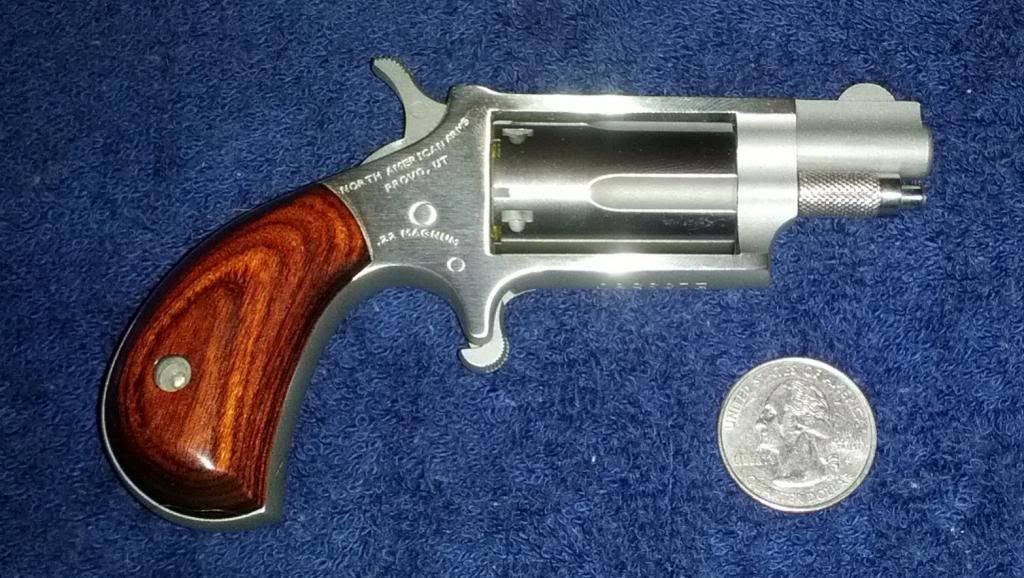
Pocket-sized personal protection

The Mini Magnum's cylinder must be removed in order to load and unload the firearm.  This is accomplished by pushing in a button on the end of the cylinder pin, then pulling the pin out of the front of the firearm.  Placing the firearm on half-cock, the cylinder may then be swung out for loading.  In unloading, the cylinder pin may be used to push out stubborn empty cases.  Once the cartridges are loaded, the cylinder is then replaced into the frame, the cylinder pin is replaced, and the gun is ready to fire.  Reloading this gun does take some time, and is not something that one would want to undertake in the heat of the moment.  You have five rounds:  make them count.

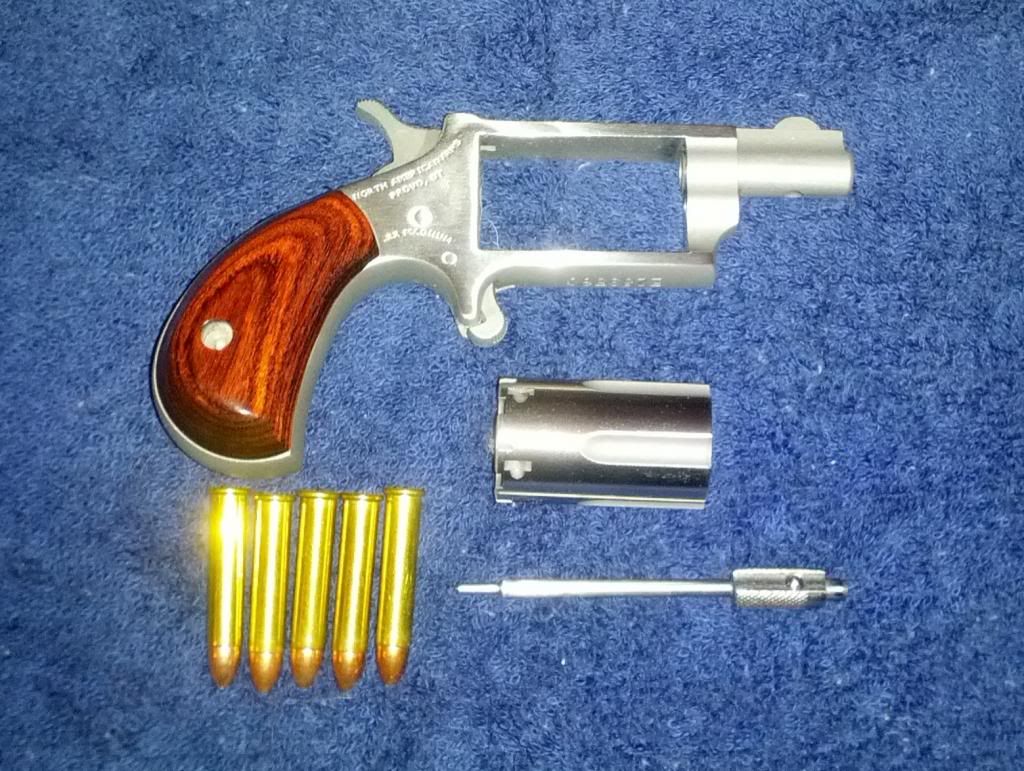
Shown with cylinder removed for loading.

Since the revolver does not have a hammer-block safety, one would normally only load four of the five chambers, so that the hammer may be rested on an empty chamber to alleviate the chance of accidental discharge.  North American Arms has developed an ingenious work-around for this, however.  Between each chamber, there is a shallow safety notch, in which the hammer may be rested, thus allowing the weapon to be carried fully loaded.
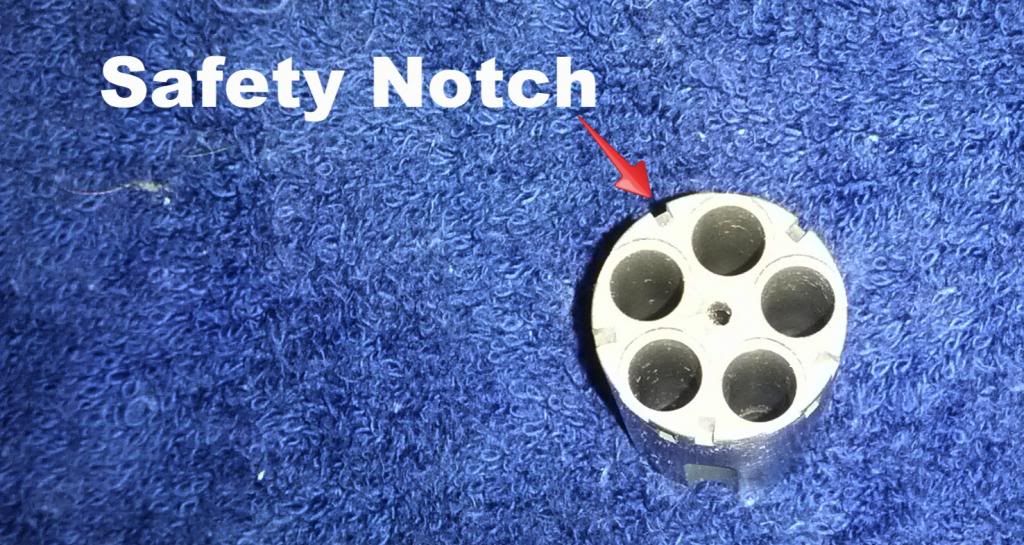
Cylinder removed, showing safety notch
 (and powder residue in the chambers)

Shooting the NAA Mini takes some getting used to.  For one thing, the grip is very small.  I can only get three fingers on the grip, with my pinky curled under it.  Also, the gun is single-action, requiring the hammer to be manually cocked before each shot.  I have found that I obtain the best results by using a two-handed grip, with my support-hand wrapped around my shooting hand, and using my support-hand thumb to cock the hammer, thus eliminating the need to change my grip with each shot.  The .22 Magnum, while a rimfire cartridge, is a powerful round.  Firing one out of a gun not much bigger than a Zippo lighter is, well...  exciting.  There is no painful recoil, but the entire gun tends to rotate barrel upward in your hand when it is fired.  With practice, one can learn how to control this tendency, however.  One thing I would stress is that hearing protection is a must when practicing with these revolvers:  the .22 Magnum absolutely roars out of this tiny little gun.

The NAA Mini is every bit as accurate as a revolver with a 1 1/8" barrel can be, once you learn how to shoot it.  I have found that using the front sight to aim results in shots being consistently below the point of aim.  Sighting along the top of the barrel, however, gives much better results.  Shooting slowly at a range of fifteen feet, I am able to get consistent three inch groups.  Rapid point shooting at the same distance, the groups open up, but I can still put all five shots inside of the 8-ring.  With more practice, I think I will be able to shrink that down to the 9-ring.

I do not pretend that the .22 Magnum is the best cartridge for self-defense.  However, I do believe that it is a serviceable round, and would certainly be capable of stopping a threat if one knows how to use it.  Nor do I think that a gun with a tiny barrel and rudimentary sights is the best option for a gunfight.  The NAA Mini Magnum is an up-close-and-personal "get off of me" gun...  what some people have called an "E.N.T." gun - short for ear, nose, and throat, meaning that the face, head, and throat would be likely areas to target with this type of weapon.  Thus, I will not be replacing my everyday carry gun with the NAA Mini Magnum.  However, I do believe that the Mini makes a great back-up gun to my S&W Model 60.  And on those occasions when I cannot carry "the Chief," at least I do not have to be completely unarmed.  The NAA Mini just gets popped into my front pocket, and I am ready to go.  In fact, since I purchased "Maggie," I have not left the house without her (so far I have been able to avoid the post office, courtrooms, and airplanes).  The Mini Magnum is one of the best ways to live the mantra:  always carry, never tell.
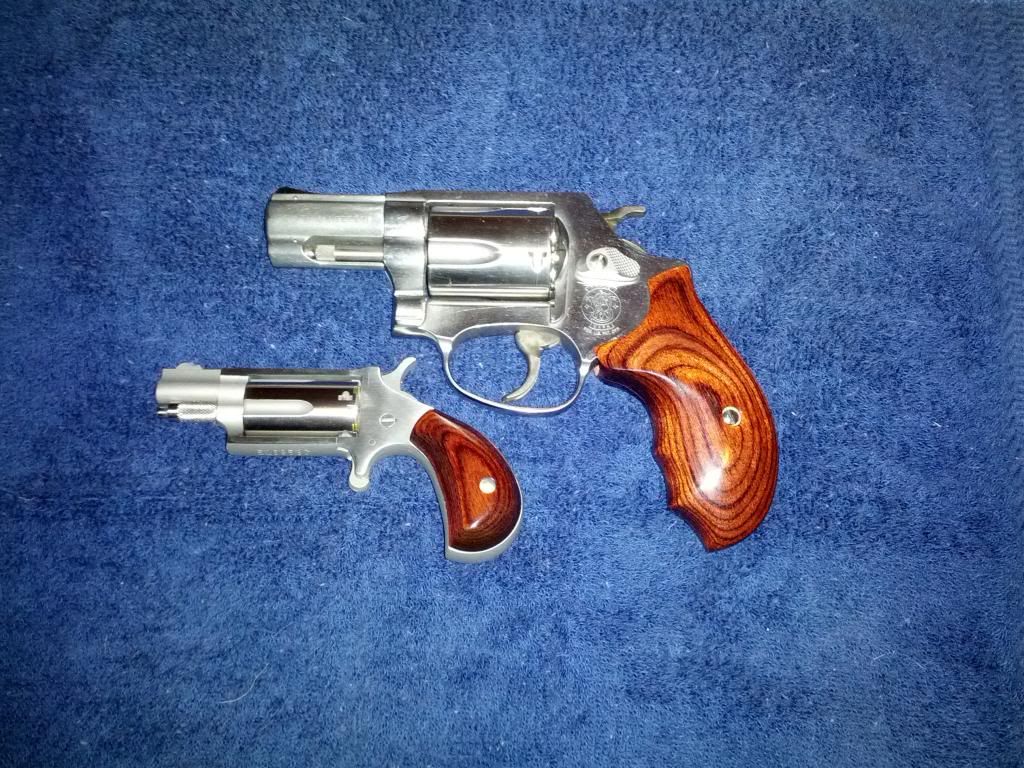
My (almost) matching pair of magnums:
S&W Model 60 .357 Magnum and NAA Mini Magnum


For more information:

North American Arms

Wednesday, August 8, 2012

Pint-sized Powerhouse: My Palmetto State / Doublestar 7.5" AR 15 Pistol Project

Addictions come in many flavors:  mine just happens to be gun collecting.  Firearms find their way into my collection for various reasons.  There are some guns that I desire due to their historical significance.  Others, I seek out because they are examples of fine workmanship, exceptional engineering, or both.  Still others have been selected due to their utility for self-defense, hunting, target shooting, etc. -  my "working guns," as it were.  And finally, there are what I consider my "fun guns":  firearms that I simply find entertaining - plinkers and the like.  And my newest acquisition falls into this last category.

I say "acquisition," but that is not technically accurate, as this particular firearm is one that I built from parts.  The first gun that I built completely from parts, actually... an AR 15 pistol.  This particular build has been in the works for quite a while:  I have been picking up pieces here and there for nearly a year. There seemed to be no rush to complete it as I originally conceived of this gun simply as an exercise in "kitchen table" gunsmithing.  However, as recent events have thrust the possibility of new gun control legislation into the spotlight, and with this being an election year, I decided that I should go ahead and finish this gun while I still had the opportunity.

AR-style pistols are nothing new, and you will find them in several different calibers.  For this project, I decided to stick with the traditional 5.56mm chambering, even though you will find many detractors who ridicule the use of this rifle cartridge in such a short barrel.  And to be honest, their arguments are not without some merit.  The 5.56mm cartridge was originally designed to be used in a rifle with a barrel 20 inches in length.  Any less than this length reduces the efficacy of the cartridge.  Now, it seems the majority of AR models on the market today are based on the 16 inch carbine barrel, a length that generally produces adequate ballistics.  As you decrease the length of the barrel, however, not only do you rapidly lose velocity (and hence energy), you also decrease the reliability of the weapon:  the AR direct impingement gas system does not operate as smoothly when it is shortened.  The short barrel does not allow the pressure in the gas tube enough time to act on the bolt in the same manner it would in a longer barrel.  The trick to getting an AR pistol to run reliably requires experimenting with springs, buffer weights, etc.  Thus, the loss of energy (affecting fragmentation of projectiles in the target) and potential loss of reliability are factors that must be considered.

After weighing my options, I decided to stick with 5.56mm for two main reasons:  first, if I am going to have an AR, I want it to be in that caliber, as that makes it compatible with my other AR, and thus parts and accessories can be shared; and second, it allows me the option of running a .22LR conversion kit, thus making this a much more affordable range gun.  And if, God forbid, I should ever have to use this gun in a defense role (it would probably fall way down the list of my options), it would still have enough "oomph" to get the job done.

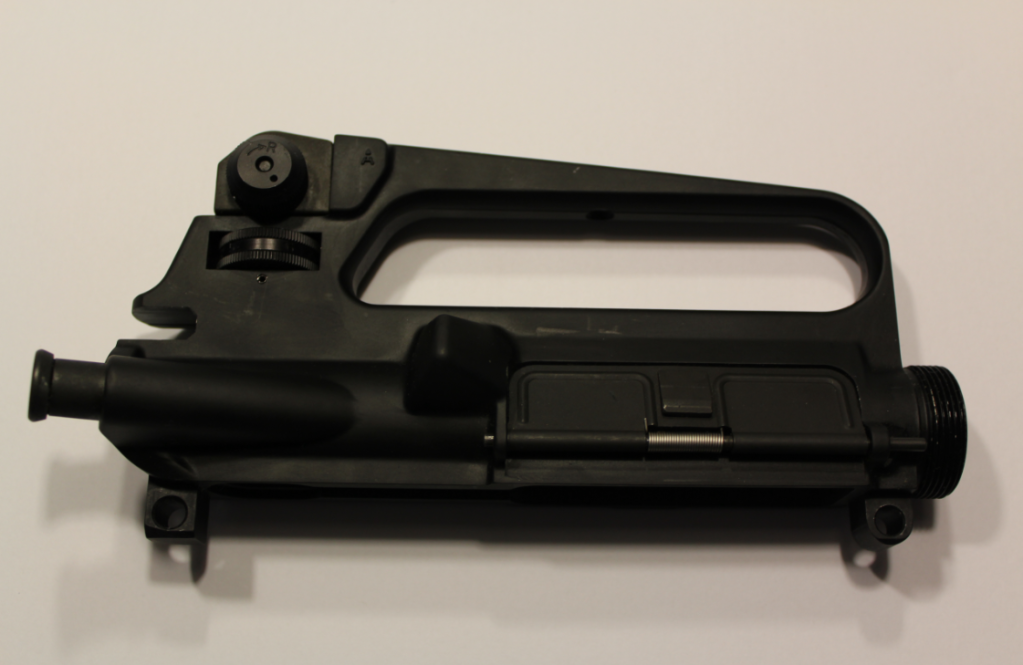
This build started with an A2 upper that I happened to have lying around, waiting to be assembled.  I really like the look of the A2, with the built-in carry handle...  it is to my mind what an AR-15 should look like (one man's opinion, true, but hey, this is my gun we are talking about).

A2 upper receiver
(image courtesy of ar15.com)
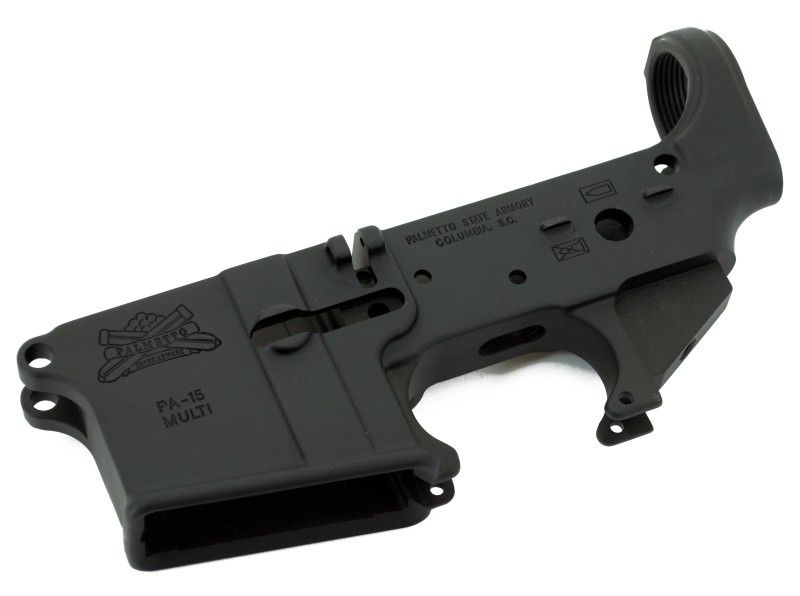
For a lower receiver, I bought a stripped lower from Palmetto State Armory.  Occasionally, you can get a great bargain on these lowers, and I bought mine on sale for $49.99 last Valentine's Day.  A fantastic deal on a fantastic lower.  Note:  when building an AR pistol, it is extremely important that you use either a lower designated as a pistol lower, or a "virgin" lower that has never been assembled as a rifle.  If the lower has ever had a buttstock attached, (even if it is clearly labled "pistol" on the receiver) you may not use it to build a pistol without running afoul of the NFA regulations.  You should always check to make sure that the lower was transferred to you as "pistol" or, (preferably) "other," not "rifle," before using it for a pistol build.

PSA Stripped Lower Receiver
(image courtesy of palmettostatearmory.com)
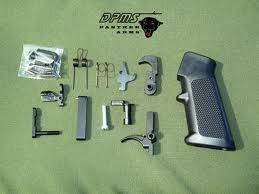
This being a stripped lower, I required a lower parts kit to finish it.  I decided to go with the DPMS kit, as I had heard good things about them, so this I picked up from Tri-Cities Gun Depot.

DPMS Lower Parts Kit
(image courtesy of surplusammo.com)
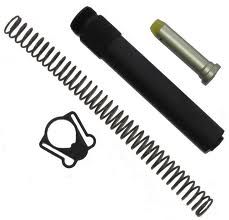
As I was assembling a pistol, I decided to go with the Doublestar Arms carbine-length pistol buffer tube.  The research I had done indicated that the longer buffer tube and spring was less prone to malfunction and required less fine-tuning to operate reliably.  This I picked up from another local gunshop, Gunslingers, in Kingsport, TN (a fantastic place for AR fans...  they have just about anything you could need or want).  I also swapped out the standard pistol buffer for an H2 buffer, as the data seems to show that 7.5" pistols run more smoothly with the heavier buffer.

Doublestar Arms Pistol Buffer Kit
(image courtesy of jsesurplus.com)
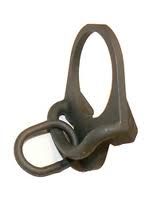
I also decided to go with the Magpul ASAP ambidextrous single-point sling adapter, which I picked up at Tri-Cities Gun Depot, as well.  I like how it allows the sling to move freely to either side of the weapon.

Magpul ASAP
(courtesy of del-ton.com)
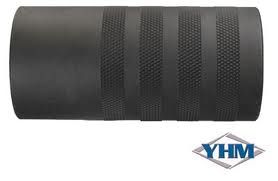
To finish the upper, I ordered a pistol-length gas tube with roll pin, and a Yankee Hill Manufacturing Mini Free Float Tube Forearm from JSE Surplus.  Since I would not be adding a vertical fore grip (another NFA no-no), I decided against a railed handguard, and instead went with the more rounded tube from YHM, which is also very light-weight as well.

YHM Mini Free Float Tube Forearm
(image courtesy of galatiinternational.com)
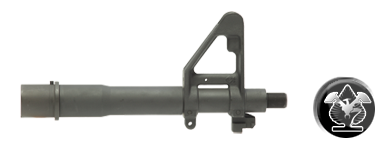
For a barrel, I again chose Doublestar Arms, and ordered the 7.5" Heavy Profile Barrel with Forged Sight Base from J&T Distributing.  It did not come with a barrel nut (almost all 7.5" ARs are fitted with free float tubes... in fact, I do not know where you would find a standard 2-piece handguard that short), but has M4 feed-ramps, and you can choose to have it chrome-lined for an additional cost (I went without chrome-lining...  just a personal preference).

Doublestar Arms 7.5" AR Pistol Barrel
(image courtesy of jtdistributing.net)
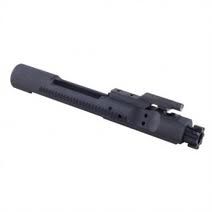
One reason I went with the Doublestar barrel is that I had also picked up a Doublestar bolt carrier group and charging handle at Gunslingers.  I know that most reputable manufacturers turn out parts that meet the industry standard for specs, but I always like to get a barrel and BCG from the same company when I can.  Sticking with the "evil black gun" look, I chose the phosphated BCG, rather than a chrome group.

Doublestar Arms Bolt Carrier Group
(image courtesy of tacticalar15s.com)
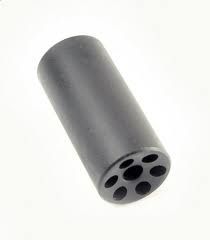
And to finish it out, I decided to go with the Levang Linear Compensator as my muzzle device.  I have read a lot of good stuff about this comp from other pistol builders.  One of the issues with the AR15 pistol is that there is a LOT of unburned powder that makes it out the end of that short barrel, resulting in a tremendous muzzle flash, and the noise and concussive force produced by firing the gun can be overwhelming.  The Levang Linear Comp addresses this by directing this gas, noise, and force forward away from the shooter, thus making the gun more shootable.

Levang Linear Compensator
(courtesy of parallaxtactical.com)
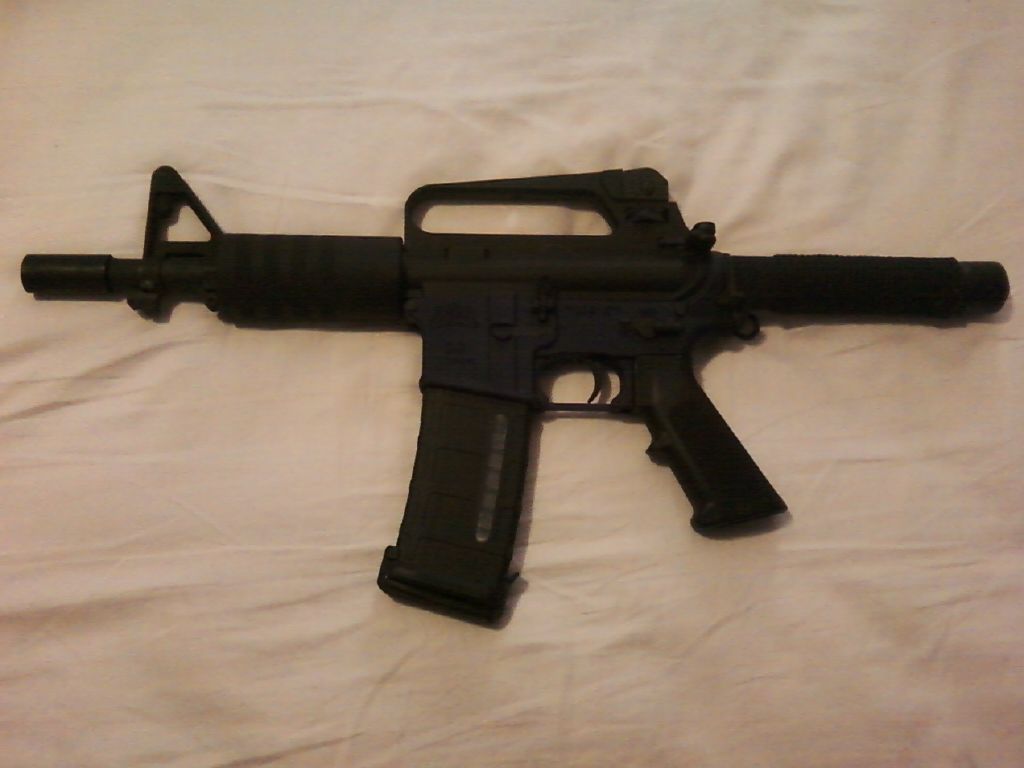
Put all of these parts together, paracord wrap the pistol buffer tube for added comfort when getting a cheek-weld, throw in a Magpul 30 round P-mag,  and the end result is one pint-sized powerhouse - the AR15 pistol.

Say "Hello" to my little friend!!
I will update this post when I have a chance to get it out and shoot it.  Not looking for any sub-MOA groups with this little one, but I imagine it will be a BLAST at the range!!  And if there are any other AR pistol enthusiasts out there, tell me about your builds...  I would love to find out what your setups are.

Oh, and one final thought:  to all of the gun forum sages out there who are so quick to denigrate the AR pistol, the .500 S&W, the Barrett .50 caliber rifle, or any other firearm, as impractical, useless, excessive, or unnecessary...  these are the same arguments that those who would take away all of our guns have been using for years.  Let us not give these people any more ammunition by turning on one another.  Do I have a need for a .50 caliber Barrett?  No.  I would love to have one for the collection, but it will probably never happen for me (no offense, Ronnie...  you make wonderful guns, but I cannot afford to feed one).  But that does not mean that they should no longer be available to those who would have one.  Just like a two-seater convertible - practicality is not the end-all-be-all.  The Second Amendment says "shall not be infringed," so let us try our best to keep it that way.

Friday, May 25, 2012

Gun Review: Rossi Model 25 Princess .22LR Revolver

As a gun collector, I am constantly on the lookout for interesting, unusual, and uncommon pieces.  Now, do not get me wrong, I enjoy shooting, and therefor I put a premium on reliability and accuracy, but I also very much am interested in the history of guns as well, and I love firearms that are more than just your run-of-the-mill, everyone-has-one models.  Such as my Remington 878 Automaster, which I covered in a previous post...  it may not be worth a great deal in monetary value, but to me, it is valuable as a piece of Remington history, and thus of firearms history.  The same can be said of my military surplus rifles:  somewhere, sometime, someone trusted his life - and possibly his nation's survival - on these rifles.  Each arsenal repair, each little ding in the wood stocks, is part of a story, and I find that fascinating.
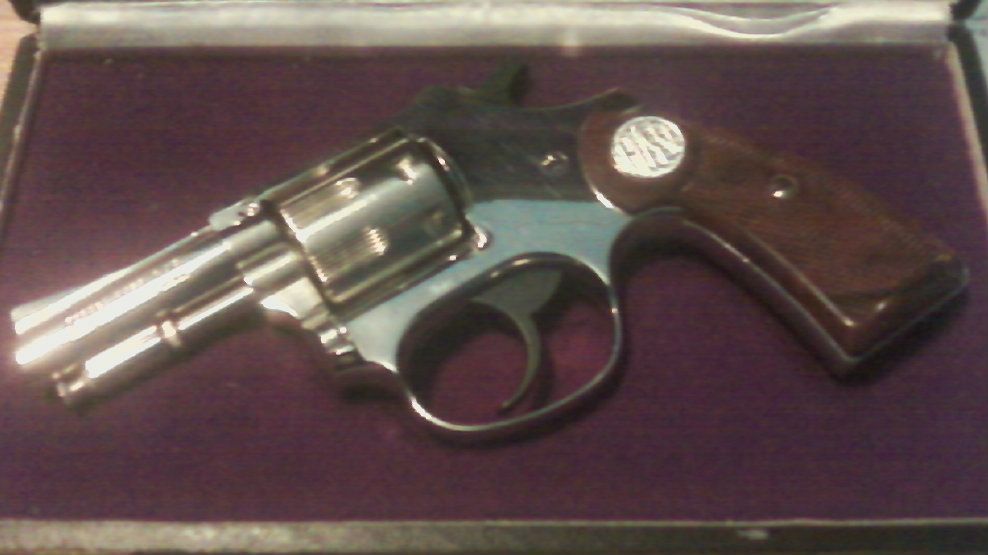
The Model 25 presentation case

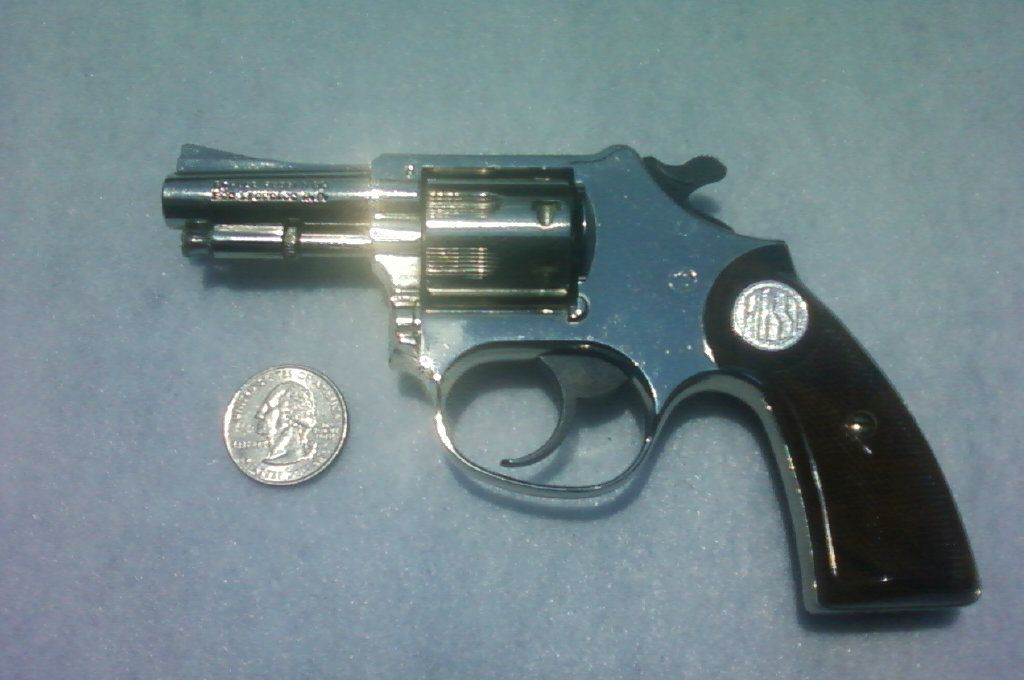
Recently, I came into possession of another little piece of history.  And I do mean little.  It is the Rossi Model 25, a petite revolver chambered in .22LR.  Known as the "Princess," this tiny little pistol is quite beautiful with its bright nickel-finish.  The left side of the barrel is stamped "AMADEO ROSSI & CIA/SAO LAOPOLDO R.S." while the right sideplate is stamped "MADE IN BRAZIL" with the Rossi trademark and the importer marking "FIREARMS INT'L CORP/WASHINGTON, D.C."  The right side of the barrel is stamped ".22 L.R."  The serial number is stamped on the frame below the grip.

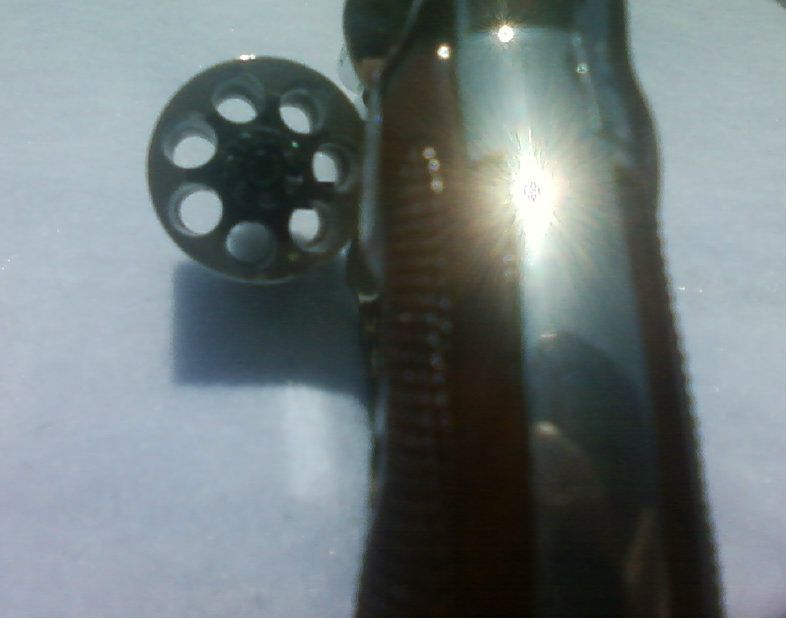
Just barely six and a half inches long, with a barrel length of two inches, the Princess is smaller than a grown man's hand (a 3-inch barrel version was also manufactured, designated the Model 13).  Despite its diminutive size, however, the Model 25 has a swing-out seven-shot cylinder with a manual ejector rod.  It is a single-action / double-action revolver, and while the trigger is quite stiff (I would estimate it at around fifteen pounds), it is smooth with no slop.  The brown plastic grips have some black marbling throughout, and they sport a round medallion (a la S&W) bearing the Rossi logo.  Actually, these are some of the nicer grips I have seen on Rossi revolvers.  The grip is very short, and leaves little room for a big hand...  this gun was definitely made with ladies in mind.


The Rossi Princess
Shown with a quarter for perspective

The frames of the Princess revolvers are die-cast of Zamak (or Zamac), sometimes disparagingly referred to as "pot metal."  Zamak is a zinc-aluminum-magnesium-copper alloy, which is actually quite strong, certainly for the frame of a .22LR revolver (Hi-Point Firearms uses Zamak for the slides on their centerfire pistols and carbines).  This results in quite a light weight pistol.


The Rossi Model 25 is a copy of the third model Smith & Wesson "Ladysmith," an M-frame revolver manufactured during the first two decades of the 20th century. The M-frame was the smallest hand-ejector frame made, and was used for the .22 Long, and was discontinued in the early 1920s.  Rossi, a Brazilian gun manufacturer (now a member of the Taurus family of firearms companies), resurrected this revolver concept, manufacturing the Model 25 for 28 years from the 50s through the mid-80s, with nearly a million of the little revolvers sold.  However, because of U.S. gun laws, primarily the 1968 Gun Control Act, relatively few Model 25s were imported into this country, all of them between the years 1965 through 1969.  It is getting more difficult to find these guns, especially in good condition.

Surprising amount of firepower for such a diminutive gun
Rossi, like its parent corporation Taurus, has a lot of detractors and, to be quite honest, not without good reason.  For a period of time during the 1980s, both companies suffered from poor quality control, turning out a large number of guns that had problems.  It does not take long for such inattention to sour consumers to a product line, especially when the primary purpose for many of these products is personal defense.  However, the early guns manufactured by both Rossi and Taurus were of quite good quality (and I understand that both companies are doing much better recently, trying to address the QC issues).  The Princess is just such a gun.  The internal parts are well-made, the cylinder lock-up is tight with no play.  The timing on the cylinder is spot-on as well, with no chamber misalignment.  It is simply a nice, tight little revolver, especially when it is compared to a lot of the other inexpensive revolvers that were being imported around the same time (Rohms, for example, which were notorious for being poor-quality).  Not too shabby for a gun that originally sold new for between $35 and $40 at your local Ace Hardware (recently these revolvers have sold for as much as $250 - $350 on GunBroker and other sites...  I call that a good return on an investment!).

One thing I have noticed, however, is that when shooting .22LR cartridges, you can get a bit of powder-flash coming from between the cylinder and the forcing cone (no lead shavings like that old Rohm used to shower me with, though).  This does not happen with .22 Shorts or .22 Longs, and I have to wonder if it is due to the newer hypervelocity .22LR cartridges being so much more powerful than the .22LR cartridges of the mid-Sixties.  I will try some sub-sonic loads soon to see if that makes a difference.  Accuracy with various loads has been quite good for a short barreled revolver.  This one is definitely a keeper.

If you have a Rossi Model 13 or 25, and have any more information on this gun, please leave a comment below.  Let me know what ammunition your Princess likes, and how well it is holding up.  There is not a lot out there on these revolvers (thanks to Ed Buffaloe at unblinkingeye.com for a great write-up, and the various gun fora from which I have gleaned some nuggets of wisdom), so anything you might have to add would be appreciated.

For more information on Rossi:

http://www.rossiusa.com/

Friday, August 12, 2011

Plum Crazy Sportical Update: NcSTAR additions

In this follow-up post to my Plum Crazy Sportical review, I will be reviewing some recent additions I have made to the original.  Finally having given in to my curiosity about the AR platform, I am now wholly given over to the customization bug.  In addition to the NcStar back-up iron sights I installed shortly after having assembled the rifle, I decided to add a reflex sight.  Also, having nearly blistered my finger on the gas block after rapid firing 100 rounds, I began to think that a vertical foregrip might be in order. And as always, the guys at Tri-Cities Gun Depot were there to make it happen.

The first addition I sought to make was the red dot.  I have always been hampered with somewhat poor eyesight, being nearsighted with astigmatism.  As a result, iron sights are often difficult for me to see.  While the aperture sight of the AR is better suited to my vision than, say, buckhorn sights, at distances fifty yards and above, I still find it hard to get a proper sight picture.  The red dot sight works very well for me, however, making it easier for me to acquire my target quickly and remain on target.  I have used red dots in the past on different rifles, most recently an SKS and a .22LR plinker, so I thought adding one to my AR would be just the ticket.

The red dots I have used in the past have all been tube styles, but for this project, I decided to go with an open reflex sight.  My choice was the NcSTAR Tactical 4 Reticle Sight.  I know that NcSTAR often gets a bad rap from the armchair spec-ops guys on the firearms forums, but most of the people I have talked to who actually own and use their products have no qualms about relying on them.  Plus, with a lifetime warranty, I am willing to give the sight a try.  The different reticles are bright, clear and, while I chose to go with the simple red dot, the option to change reticles depending on the shooter's need is a big bonus to me.  The sight also has adjustable brightness levels, ranging from 1 to 7, so the shooter can pick the level that suits his or her need.  The kit comes with the sight, a tiny screwdriver to adjust the locking screws, an allen wrench to tighten the scope mounts as well as to make elevation and windage adjustments, two batteries, a cleaning cloth, and a rubber lens cover.  The sight was a cinch to mount on the top rail, and just a few minor tweaks of the reticle adjustments had it dead on.  One other thing I like about the sight is that it absolute co-witnesses with the iron sights.

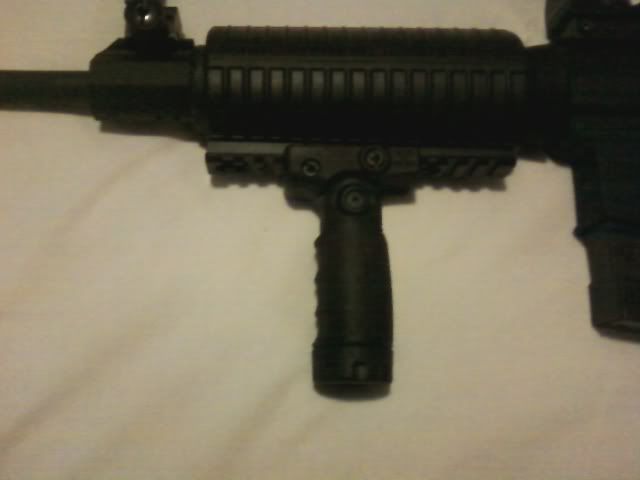
My next addition was the foregrip.  The DPMS Sportical upper I bought comes with the Glacier Guard handguards, which are apparently proprietary to DPMS.  The holes on the bottom of the guards do not line up with all mil-spec weaver rails.  I first attempted to add a ProMag rail, but was unable to make it work with the Glacier Guard.  Somewhat frustrated, and not really wanting to change out handguards at this point, I was assisted in my quest by Tom and Brian at TCGD.  Tom showed me that (who else?) NcSTAR has an M4 Hand Guard Weaver Rail, which has a floating mounting screw that enables it to mate up with different handguards, the Glacier Guard included.  Feeling that my search was over, I started to look at foregrips, when Brian pointed out to me that the internal fins on the Glacier Guard (which give the handguards the heat dissipation from which the name stems) prevented the washer and nut from fitting properly.  Now this is where  it gets good:   with a great deal of care and patience, Brian used a file and knife to notch out the fins enough to allow the washer to fit, and the rail went on as though it were designed for this particular handguard.  In the meantime, I had picked out the Vertical Folding Grip by the Mako Group.  It has a great feel to it, fits my hand well, and as a bonus it has a battery compartment inside that I now use to store my spare battery and adjustment tools for the red dot sight.  And while I shouldered the rifle and decided where I wanted the grip to go, Tom tightened down the mounting screws to lock it into place for me.  These guys could not have made this any easier for me.  Now that is customer service.

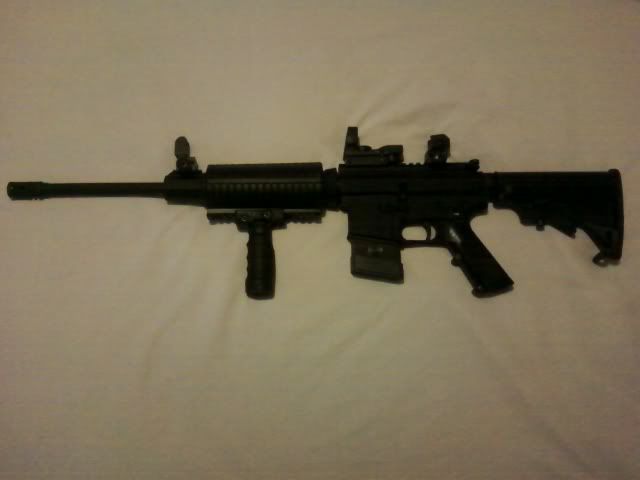
An hour later, I was on the range, blasting away at some aluminum cans at fifty yards.  Everything works just as it is supposed to.  The red dot was right on, and did not lose zero through 100 assorted rounds of Federal .223 FMJ and 5.56 FMJ.  The barrel got smoking hot, and even the Glacier Guards were uncomfortably warm to the touch, but the Mako foregrip made shooting comfortable, and really enhanced my aim shooting freehand.  It is hard to describe the enhanced ergonomics of using such a shooting aid...  it just makes it feel so much better.  Here is a crappy cell phone picture of the Plum Crazy Sportical as she looks now (the magazine is a Thermold 20-round polymer):


A close-up of the vertical grip and rail:


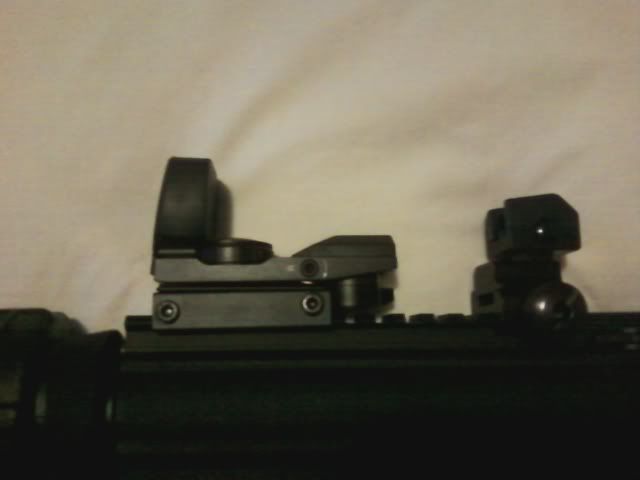
The NcSTAR red dot and rear BUIS:


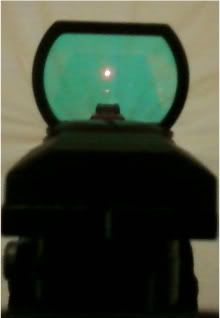
View through the red dot (setting 7):


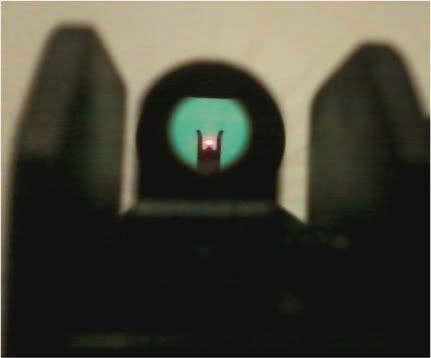
View of red dot and BUIS co-witness (setting 7):


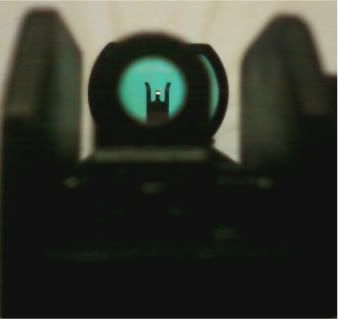
View of red dot and BUIS co-witness (setting 1):


Thus far, I am really liking this rifle.  It is accurate, has been totally reliable to this point, and is a lot of fun to shoot.  I will continue to post updates with respect to any of the parts I have added to this gun, to let my readers know how they continue to function.

Finally, just a thank you to Tom and Brian at the Gun Depot for their help in picking out my accessories, and helping me to install them.  When people ask me why I started shopping at Tri-Cities Gun Depot, I tell them it was for the low prices.  When someone asks me why I keep shopping there, I tell them it is because of the unparalleled service I receive there (and the prices are still the best in town, too).

Sunday, July 3, 2011

Book Review: The Complete Gun Owner by James M. Ayres

There are few things I enjoy more than shooting, but sometimes Mother Nature just does not want to cooperate.  So there are often times when I have to find some other way of occupying myself.  Luckily, for the firearms enthusiast, there are many related endeavors for which we can use our "down time," such as cleaning our firearms, reloading, rearranging our gun safe (yes, I have been known to do this), sorting ammunition, etc.  Rainy days also give me an opportunity to keep abreast of what is new in the world of shooting sports, by reading some of the sporting magazines that are available, or picking up a book on firearms.  Most recently, I picked up a copy of The Complete Gun Owner, by James M. Ayres (Gun Digest Books, 2008), and would like to take this opportunity to give a review of this particular book.


(Image courtesy of amazon.com)  The Complete Gun Owner is written on a very basic level, with the intent, I imagine, to make the information contained therein accessible to readers who are just getting involved in the shooting sports.  The sub-title of the book is "Your guide to selection, use, safety, and self-defense," and the book undertakes to cover each of these areas.  It is 271 pages long, and contains many color photographs.  The book's appendices contain information about federal and state firearms laws; state game and wildlife agencies; a list of gun, safe, and case manufacturers; and a web directory.  An index, however, was not included.

The book is divided into four main sections (five, counting the appendices).  First is a section of gun selection. Second, a section on basic gun use, including how to shoot, the care and cleaning of your guns, hunting, and what the author refers to as the "Tao of Shooting".  Third, a section on gun safety.  And lastly, the book covers self-defense with a gun.  Each of these sections is further broken down into chapters, each focusing on a specific aspect of the overall subject (for instance, in the basic gun use section, there are individual chapters on how to shoot handguns, rifles, and shotguns).

One thing that impressed me early on with the book is that the first chapter is dedicated to making "A Case for the Twenty-Two."  Unlike some other shooting enthusiasts, I still feel that the .22 is a great cartridge, especially for the beginning shooter.  And the author points out that this cartridge is useful for helping a first time shooter become acquainted with the sport, without developing bad habits, such as "the flinch," which can be brought about by starting off with a high-recoil cartridge, such as a .357 Magnum or a .45 ACP.  So it was refreshing to see a book devote a whole chapter early on to recommending the .22 as a viable weapon.

It is in the very first chapter, however, that I also started taking issue with some of what the author was saying.   Ayres makes it clear early on that he is not a fan of the revolver.  On page 33, he states that semi-automatics are "subject to fewer mechanical problems under field conditions" than revolvers.  Really?  I would like a citation for that assertion.  I, personally have had mechanical failures with nearly every semi-automatic I have ever owned, some due to faulty ammunition, some due to bad magazines, some due to operator error, and some due to problems with the actual gun. I have yet to have a single mechanical failure of any kind with a revolver...  ever.  The closest I have ever come is a failure to fire due to a bad primer, in which case I simply pull the trigger again and "bang."  Revolvers are one of the most user friendly platforms for new shooters:  there is no slide to have to rack, one need not worry about "limp-wristing," no safeties to have to learn, etc.  The author also denigrates lever-action and bolt action rifles in favor of the semi-automatic (that is until page 104, when he talks about his bias "for" bolt action rifles for hunting...  er, ok...  which is it?).

Some of the firearms that the author recommends seem to be odd choices, based on the audience to whom he is reaching out.  For a book aimed at beginning shooters, the author recommends the Ruger Mk III and the Browning Buckmark,  two excellent firearms by most anyone's standards.  However, for someone who has had to disassemble and reassemble these pistols, recommending them to a novice seems like a bad idea.  Ayres also seems to recommend the Beretta Neos and Sig Sauer Mosquito, even though he states that he has no personal experience with either weapon, and he is just going by the reputation of the company.  Which is like recommending someone buy a Ford because they have such a great reputation -- on one hand you might wind up with a Mustang, but on the other hand, you might end up with a Pinto.

Aside from the wealth of opinion that the author shares in the book, there are also factual inaccuracies, poor editing, and photographs that do not seem to belong.  Did you know that the AK-47 is chambered in 7.61x39?  That's ok...  it's news to the Russians as well, as they are still operating under the mistaken assumption that it is 7.62x39.  And sure, this may just be one more instance of the editor missing something, and maybe it is not that big of a deal, or maybe it is to the new shooter who is now looking for a non-existent cartridge.  Then there is the assertion that the Remington 552 BDL is basically the same gun as the 597, "without the fancy checkering."  Sure...  other than the fact that the two guns have completely different actions, the 552 has a tubular magazine while the 597 has a removable 10-round magazine, and the 552 will chamber and fire .22 Short and .22 Long as well as .22 LR, whereas it could be dangerous to attempt to do so with the 597.   But yeah, other than that, the same gun.

Then the author offers up such gems as "eighty-five to ninety-five percent of the effectiveness of any shot is determined by shot placement," in big, bold font on pages 167-168.  Yet nowhere does he offer any statistical evidence to back up this claim (one might as easily say that 100% of the effectiveness of any shot is due to shot placement, in that if you miss the target completely, it will have no effect at all).  Or when he states that twenty-two pistols are commonly carried by Israeli assassins (and likewise U.S. operatives) because they "might only receive a few days training and practice with a handgun" (page 195).  Citation, please?  And this brings us back to the chapter on twenty-twos in that Ayres states on page 29 that the .22 is commonly used in a defensive role by "individuals and members of certain organizations."  Well, I guess if Israeli assassins can be trained to use a .22 in a few days, then why should a novice gun owner be any different, right?

On page 179, Ayres discusses the handgun shooting positions used in defensive shooting.  The first position he covers is hip shooting (no relation).  In the first paragraph, he states that "(m)any experts deride hip shooting as being totally useless....  Perhaps they are setting their sights incorrectly."  Setting their sights incorrectly?  OK, well, Mr. Ayres is holding himself out to be an expert on firearms, not anatomy, after all.

Poor editing is, in my opinion, the primary problem with this book, and it is most clearly evidenced by photographs that are placed throughout the text in a seemingly random fashion.  For instance, chapter 5, "How to Shoot a Shotgun," is illustrated with a total of nine photographs:  seven photos of someone wielding a Ruger Mini-14 semi-automatic rifle, one photo of a handgun's sight picture, and one photo of someone wielding a single-shot rifle.  Not a picture of a shotgun to be seen.  Other masterful touches of editing include two copies of the same exact photograph on the same page (Wait, this looks familiar... where have I seen this photo before?  Oh yes, in the aforementioned shotgun chapter.), one with the caption "Correct sight picture," and the other with the caption "Correct sight alignment." There is also a firearms terminology section at the beginning of the book  in which the terms are not in alphabetical order. And let us not forget the editorial comments that were left in the text when it went into print, such as when the editor asked the author to provide "some specifics that make it a "good shooter," when referring to the Savage Model 64.

Taking all of this into consideration -- the overly opinionated approach by the author, the poor editing, and the reliance upon anecdote as opposed to documentary evidence -- means that I just cannot recommend this book to anyone, especially someone new to firearms.  While there may be nuggets of wisdom hidden in this book, there is also enough that is inaccurate or misleading to cause confusion in someone who is just getting his or her feet wet in the shooting sports.  I would look to other texts, such as those penned by Massad Ayoob, if you are looking for well-written, accurate books on firearms, shooting, and self-defense (The Gun Digest Book of Combat Handgunnery is just such a book).

Tuesday, June 21, 2011

The $500 AR 15 Project -- My Plum Crazy DPMS Sportical

The AR 15...  for many, it is the end-all be-all of rifle platforms.  And for good reason:  it can be just about anything you want it to be.  From short barrel patrol rifle to long range, heavy barreled varmint gun, the modular nature of the AR 15 lends itself to customization like no other weapon.  Stocks, handguards, pistol grips, sights, barrels, gas blocks, fire control groups...  there is nothing on an AR that cannot be made to match a particular shooter's preferences.  Even caliber is up for grabs:  the standard 5.56 / .223 can quickly become a .204, 5.45, 6.8, 7.62, 9mm, or even .22LR.  The choices are seemingly endless.

And in spite of this, I have never owned an AR platform.  And to be honest, until recently, I have not felt as though I have been missing anything.  I have been very happy with my .22s, my SKS, and my milsurps.  And I suppose I still thought of the AR in terms of the original M16s that our boys in 'Nam got saddled with -- clumsy, prone to jam, impossible to keep clean, and generally disparaged by those veterans who chose to share their stories with me about their time in the service.  Now, a lot has changed since the Sixties (thank God), and the AR has benefited from some technological enhancements that have made the platform much more reliable.  The direct impingement gas system still needs care and cleaning, but you need not be fanatical in your fastidiousness anymore.

Recently, I had a change of mind, and decided I would like to join the thousands of AR enthusiasts and see what I have been missing.  And to do so, I also decided to undertake a sort of self-imposed challenge:  to build a lightweight AR, and to do so for $500.

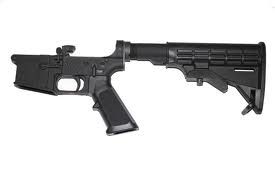
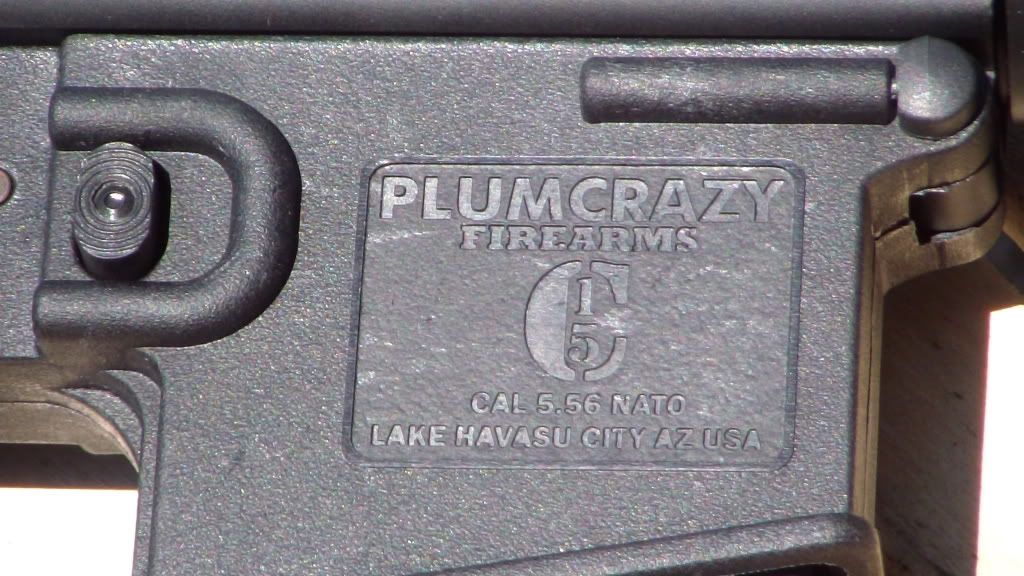
Now, those of you who have ARs know that this is a nearly impossible task.  Nevertheless, I had an ace up my sleeve.  There is a company in Arizona called PCF manufacturing who turns out polymer AR lowers (C-15) under the name brand "Plum Crazy."  These lowers are made of a "space-age" teflon-impregnated polymer, designed to near mil-spec dimensions, meaning that they will mate with just about any mil-spec AR 15 upper. And these lowers cost $130...  complete.  That's right, this is a complete lower, including fire control group, bolt catch, mag release, and six-position collapsible stock, all for $130.  Interestingly, the fire control group includes a polymer hammer and trigger, the mag catch and release are polymer, and even the take-down pin and pivot pin are polymer.  All of this equals reduced weight.

(Image courtesy of clark-corner.com)  Before I went Plum Crazy, I did a lot of research on the product.  I have had several polymer pistols, as well as polymer stocked rifles (a .30-'06 and an SKS, for example), so I am not too worried about the polymer not being able to handle the stresses involved.  Especially considering the majority of stress is absorbed by the upper on an AR.  I did come across a few instances of lowers that had broken, but for every bad experience I found, I read three or four positive reviews.  And more often than not, the naysayers were not owners of the Plum Crazy firearms, but "knew a guy who had a friend who's brother had one blow up..."  Not exactly dealing with raw data in that situation.

Most importantly, however, is that the company PCF Mfg. offers a 100% lifetime warranty on their products. I dig a company that will stand behind its product.  And even the few people I found who had experienced broken receivers (usually their own fault due to dropping the gun or torquing the receiver while trying to mate it to the upper) had found the company quick to replace their lower.  And they are made in the USA.  I figured it would be worth a try.  It certainly helps my bottom line, both with weight and cost.

Luckily for me, a local gun shop, Brackin's Gun Alley stocks the Plum Crazy (March 2013 update:  unfortunately, I can no longer recommend Brackin's Gun Alley, and I will just leave it at that).  I was able to pre-order one for $130, which means that after background and tax, I was out $153.  When I got the receiver, I was suitably impressed.  The lower seemed well made, and was thicker and stronger than I had imagined.  The finish has a few minor molding remnants on it, but could be easily removed.  The trigger was what astonished me, however...  while not a match group by any stretch, it is very crisp, with little to no slop, and breaks cleanly at between  4.5 and 5 lbs.  Extremely good for a stock trigger in this day and age.  The one thing that I found fault in is the safety.  An AR safety is designed such that it cannot be engaged if the hammer is in the forward position -- the hammer must be cocked back before you can put the safety on.  The Plum Crazy safety, however, can be engaged while the hammer is forward.  Not a deal breaker, but it means it is not mil-spec in this regard, and is something that prospective owners should be aware of.

Now that I had my lower, I needed an upper to go with it.  In keeping with my light weight requirement, I knew I was going to be looking at a pencil profile barrel, most likely the minimum 16".  I also decided to look at some "slick side" receivers:  receivers that do not have the forward assist, shell deflector, or dust cover.  As a lot of AR fans will point out, these uppers are not mil-spec, but then, neither am I.  I am not going to be heading out to the sandbox anytime soon, so I really do not need the dust-cover...  this is a plinker, plain and simple.  Forward assist is just a way of getting a few more shots in before cleaning your gun, or for forcing a frozen bolt forward in sub-zero temperatures, and is not necessary for my purposes, either.  And lastly, as a righty, the shell deflector would do me no good at all.

So, keeping this in mind, I decided to go with the DPMS Sportical 5.56 upper from MidwayUSA.  The Sportical is designed on the lo-pro receiver, meaning flat-top, no sights, and a railed gas block.  It is designed for someone who is going to add optics to their AR (which I am...  I have a red / green dot sight that needs a good home).  It also comes with your choice of pencil profile or heavy barrel, both in 1 in 9" twist.

(Image courtesy of midwayusa.com)  Well, it just so happens that MidwayUSA had these uppers on sale for $360.  So I ordered one.  I got it via UPS today, and I assembled the lower and upper this afternoon.  Having read about the tight fit many Plum Crazy owners were experiencing, I was poised to expect a difficult time assembling the rifle.  It was not to be, however:  the pivot went together quite easily, and the rear of the receivers popped right together with just a little pressure from the heel of my hand.  Both pins went in snugly, and the two halves fit as though they were made for one another.

I finally had my AR.  And I came in just over my goal of $500, at $513.  Well, almost.  I forgot the magazine.  A quick trip down the road to the gun shop fixed that.  Add a 30 round steel magazine for $14, and that brings us to a grand total of $527.  If it weren't for Tennessee's insane sales tax and the background check, I would have made it.

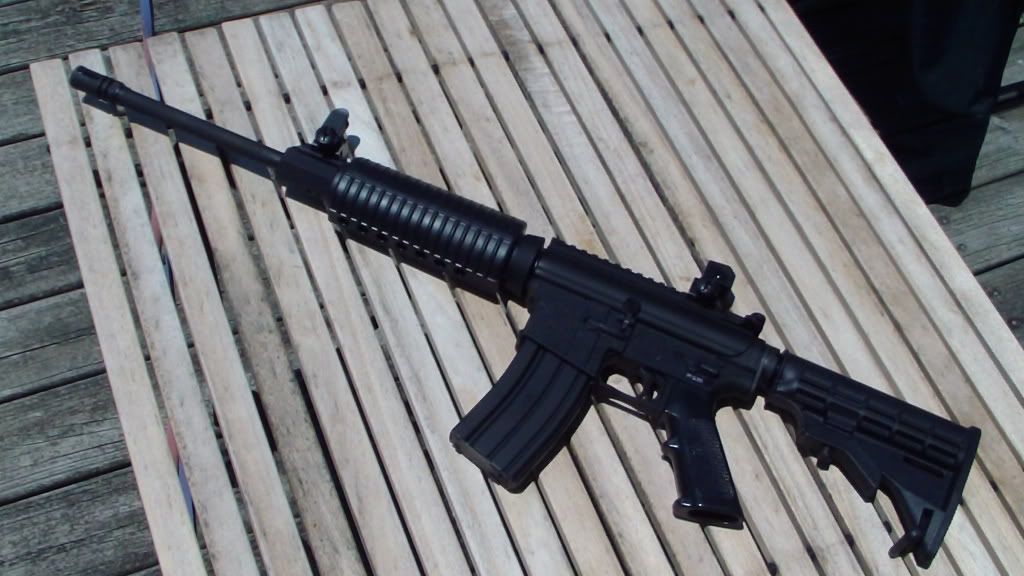
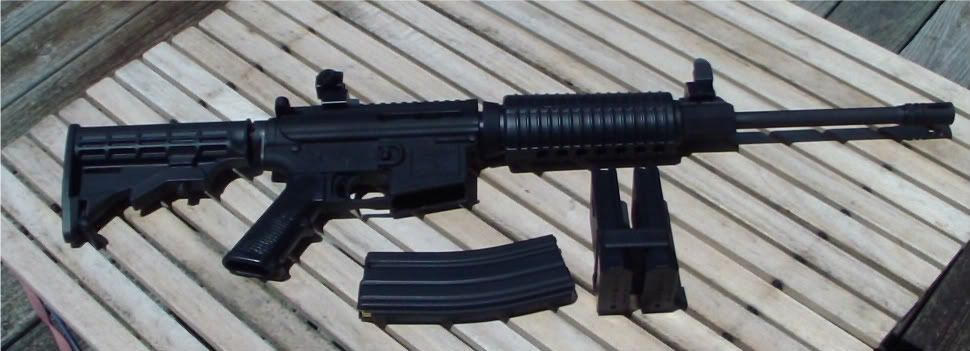
So, I didn't make my goal of $500, but I came close enough to make me happy.  This rifle isn't going to make the front page of ARF.COM, and I am sure that many AR purists will turn their noses up at it, but it fits me well.  I quite like it so far.  Especially the way this gun shoots.  It is almost ridiculously light, just over 6lbs with red dot and 30 round magazine.  I may look at adding back-up iron sights at some point, but for now, for my purposes, the red dot is sufficient.  I think it is going to be a great little rifle.  I have put 25 rounds through it (Federal .223 bulk box 55 gr. FMJ), to sight in the red dot, and to break in the barrel, cleaning after each round per the instructions from DPMS.  Each round chambered and fired flawlessly, spent brass was positively ejected to my right, and the plastic lower hasn't blown up yet.  When I get through the break-in process, I will post some pictures or a video of how it is shooting.  It may be time to break out another Osama bin Zombie target!!

Update:  I picked up a set of iron sights at Tri-Cities Gun Depot this week, and switched them out for the red dot.  Here are some pictures of the Plum Crazy Sportical setup:


Monday, June 6, 2011

MetroArms American Classic II -- EGW magazine catch and Pearce grip insert review

This episode of Shooting from the Hip is a follow-up to my review of the MetroArms American Classic II model 1911 pistol.  Specifically, I recently completed my first two upgrades, and I wanted to share with you what I changed, as well as why I did so.

Now, you may be asking yourself why, if I like the ACII so much, I felt the need to change something.  Well, for one thing, it is a 1911, after all, and one of the beautiful things about this pistol is that it is a platform that begs one to customize it to one's own preferences.  From grips, to sights, to triggers, hammers, even guide-rods, there isn't much on the 1911 that cannot be tweaked to fit the individual shooter.  In this particular case, my first upgrade was to add a Pearce rubber grip insert.


(Image courtesy of pearcegrip.com)  Now, while I am a big fan of wood grips on a 1911, the slim aspect of the 1911 doesn't fill my hand very well.  I have big hands, and I am used to double-stack guns that are wide enough to fit my hand well.  Part of the attraction of the 1911 though is the slimness, making it a good carry pistol, easy to conceal, so I did not want to lose that aspect.  My choice, therefor, was to try the Pearce grip insert:  a rubber insert that adds finger grooves to the frontstrap, while not greatly altering the thickness of the grip itself, and still allowing the use of the wood stocks.  Installation could not be simpler:  simply unscrew the grips, put the grip insert on aligning the precut holes over the grip screw bushings, then replace the grips.  The insert is cut generously, leaving some trimming to be done, but an X-acto knife makes quick work of that.

Range time with the new grip definitely showed a difference in the handling of the pistol.  The rubber grip afforded me a firmer grasp on the firearm, and it seemed to point more naturally.  Whereas before I installed the Pearce grip, recoil would occasionally cause the pistol to shift in my hand, I found that this was no longer the case with the new finger grooves.  Speed and accuracy of follow-up shots increased perceptibly.  I am curious as to whether the grip will prove to be durable, since the rubber under the stocks is rather thin (by design, of course), but time will tell.

The second modification I made to my ACII was to install a new magazine catch.  The one issue I have had with the pistol is that on a couple of occasions, it has failed to chamber a round when I have manually racked the slide.  I have not had this issue when using the slide release, only when "slingshotting" the slide.  This issue has been mentioned on a couple of firearms forums, as well.  It seems that the magazine catch on the ACII may be a bit low, allowing the magazine to sit a fraction of an inch lower in the magwell than normal.  This causes the top round in the magazine to have a bit of a higher jump to make it into the chamber.  Not much of an issue with round ball, but it can cause hollowpoints to jam.  As I intend to use this gun for home defense and possibly self-defense, it must reliably cycle hollowpoints.

One solution to this problem that I discovered on the M1911 forum (a great place to find information about this amazing weapon platform) was to change out the factory mag catch with a replacement that is machined to hold the magazine higher in the magwell.  One such product is manufactured by the company EGW, or Evolution Gun Works.  The HD Higher Mag Catch is available in either blued or stainless, is milled from solid 4140 Chromoly steel, and is designed to hold the magazine .020 inches higher than a standard mag catch.

While the company states that the part should fit "in most good quality 1911s," like any other "drop-in" 1911 part, some fitting is often required.  This was the case with the ACII:  a couple of minutes of light grinding and buffing, and the catch fit perfectly.  And it works as advertised.  The factory catch allowed the magazines to sit just a fraction of an inch lower in the magwell, and I could hold up on the bottom of the magazine and it would move ever-so-slightly up.  With the EGW catch, the magazine base is flush with the bottom of the magwell -- a nice, tight fit, holding the top round in a more direct line with the chamber.  Hand racking the slide several times with three different magazines showed that the rounds fed much easier into battery.  Pressing the EGW catch still allows the empty magazines to fall away freely, as well, so there should be no issue with tactical magazine changes.

After another 50 rounds (Federal 230 gr. FMJ) through it today, with no failures of any kind, the American Classic II by MetroArms continues to impress me.  It is definitely worth looking at if you are interested in a 1911.  I would also recommend looking at what EGW has to offer, with respect to aftermarket 1911 parts.  The website is easy to navigate, ordering was simple, and delivery was fast.  Three things I look for in an online seller.  You might also check out what Pearce has to offer, not only for the 1911, but for a variety of other pistols as well.

Monday, April 11, 2011

Website Recommendation: Tennessee Gun Owners Forums

I have a confession to make:  not only am I a gun lover, but I am also a nerd.  That is right, a nerd...  as in a major technophile.  I love computers and technological gadgets almost as much as I love a well-made firearm.  One reason I started Shooting From the Hip is that it gave me a means of combining two of my passions in a way that lets me share my interests with other like-minded individuals.

Over the last few years, I have become addicted to internet forums (ok, it really bugs me that my Latin education tells me it should be "fora," but spell-checker refuses to acknowledge that fact), and I currently belong to several firearms and shooting sports related sites that provide me with a lot of good information, first-hand anecdotes, and well-written expositions on guns, manufacturers, ammo, accessories, etc.  Of course, there is also the flip-side of trolls, snobs, idiots, and liars that one has to deal with, as in any group that is open to the public.  The anonymity of the internet just seems to exacerbate this, however, and I often find myself getting frustrated at the sheer volume of worthless posts, snide remarks, and personal jibes I must wade through in order to sift out those nuggets of useful information which reside hidden away under all the detritus.

There is one website that I belong to, however, that rarely disappoints me in this respect.  The Tennessee Gun Owners Forum is exactly what the name implies:  a place where Tennesseans can come to talk about guns, as well as other subjects.  There are members from all three Grand Divisions, as well as transplants in other States who are maybe a little homesick, or who just want to let those of us who still live in the Volunteer State know just how good we have it here.  It is interesting to get feedback from the other areas of the State on such things as gun and ammunition prices, where to go and what to do if you are visiting another city, etc.

Sub-forums exist to appeal to various interests, including separate areas for handguns and longarms, gunsmithing, accessories, ammunition and reloading, carry issues and self-defense, women and firearms, hunting, politics (local and national), and many others.  One of the more useful sub-forums is the "Carry Prohibited Locations" area, where members can post the name and location of various businesses that have posted "gunbuster" signs, not only notifying other HCP holders where they cannot carry, but also encouraging them to write the businesses in order to spread the word that "no gun = no business."  TNgunowners are a very proactive lot, and are not shy about sharing our views with businesses that feel the need to encroach on our right to bear arms.

The site is free to join, and they rely on corporate sponsors and donations from members for the day-to-day operation and maintenance of the forum.  Many of the sponsors are local businesses who have a separate section where they can post items for sale, specials, sales, store hours, and other useful information.  Likewise, there is a classifieds section for members to list items for sale (or items wanted), although one must be a site donor in order to list items in this section.

A good firearms forum is a wealth of information, where one can learn a great deal about any number of issues.  Tennessee Gun Owners forum is just such a place.  Even if you are not fortunate enough to live in our great State, I would still invite you to stop by and check out the site.  You will find a great bunch of men and women who know a thing or two about guns, and they are always willing to help someone who may be experiencing technical difficulties, or maybe just looking for some information to help them make an informed decision about a future purchase.  But most importantly, they are all there to have a good time with people who share their love of firearms.  And they would love to have you join them, as well.

http://www.tngunowners.com/

Sunday, November 28, 2010

Gun Shop Review: Tri-Cities Gun Depot, Elizabethton, TN

Today, I thought I would write my first review, and as my subject, I have chosen a local gun shop.  Before I begin, however, let me make a couple of things clear:  first, the following comments are my opinion only.  I do not hold myself out to be an expert in this field, I am simply sharing my experiences at this particular establishment.  Second, my commentary is based solely upon my own experience with this particular dealer.  I make no guarantees as to how your own experience may relate.  Caveat Emptor.

Now that the disclaimers are out of the way, let's talk gun shops.  I love gun shops.  I like few things more than to walk into a gun shop, peer into the glass cases at the polished steel of revolvers, handle a quality 1911, and stare longingly at the racks of rifles and shotguns hanging on the walls.  I can spend hours perusing accessories:  lasers, spare magazines, replacement grips, cleaning supplies, etc.  If I could design my own air freshener, it would smell like Hoppes #9.  I like hanging around other gun people, discussing things only other gun people care about, like twist rates, drop-in replacement hammers, or how much IMR 4350 to put behind that Barnes 168 grain Triple Shok X boattail.

But when I am shopping, I am also concerned about such things as customer service, a good selection of quality items, and competitive prices.  I am not a high-maintenance shopper:  I do not require someone to hold my hand and walk me around the store to find certain items.  However, I do not want to be ignored, either.  Recently, I spent ten minutes standing at a counter waiting for a sales rep to assist me, while the employees were busy talking to one another about their previous evening's exploits.  This is unacceptable behavior (and will be discussed in a forthcoming review).  When I find a store that has what I am looking for, in terms of service and selection, I will continue to send them my business.  And I am willing to drive a bit farther down the road in order to patronize a shop that has these qualities.

Tri-Cities Gun Depot, in Elizabethton, TN, is just such a place.  TCGD is locally owned and operated by two great guys, Tom and Brian, who really know their guns.  They are friendly, and are always helpful.  Not once have I felt as though I was being ignored, and in fact, most times I have been in the shop, the guys have gone out of their way to make sure I was getting the information I needed.  What is more, it seems like they have personal experience with just about every type of firearm in the shop, which is useful when you are comparing similar firearms.

The shop boasts a great selection of firearms and ammunition, and they offer a number of accessories as well, such as Blackhawk and Uncle Mike holsters, optics, cleaning kits, and even OC sprays and stun guns.  Gun brands include Smith and Wesson, Ruger, Glock, Kahr, Kel-Tec, Taurus, Kimber, Springfield, Walther, Remington, Savage, DPMS, Rossi, H&R, and many more.  Pistols and revolvers, rifles and shotguns, this store has it all...  and if they do not have it in stock, they can probably get it.  Want a stripped lower to do your own AR build?  They got it.  And the complete parts kit to build that lower, as well.  Or, if you are not so mechanically inclined, you can get an AR, already assembled and ready to go to the range.  Or perhaps you reside in the AK state of mind...  they got you covered as well.  870 with adjustable stock and heat shield?  Yeah, they've got that.  Too pedestrian for your tastes?  What about a Saiga 12?  Check.  With the drum.  Oh yeah, now we're talking...

What is more, you get all of the above, along with very good prices to boot.  TCGD is usually within just a few dollars of the lowest prices I have seen on comparable guns for this area.  And to be honest, I am more than willing to spend a little more for gas to drive a few miles out of my way for the good service, especially since I know I will be making up the difference with the lower prices.

To date, I have bought five firearms from TCGD, and that includes the last four firearms I have purchased.  And while I still go to other gun shops, I doubt seriously that I will buy firearms from anyone other than the Gun Depot.  I highly recommend this dealer to anyone who is looking to make a firearms purchase.  Stop by and talk to Tom and Brian, and see what the Tri-Cities Gun Depot has to offer.  I do not think you will be disappointed.

Tri-Cities Gun Depot
1760 West Elk Avenue
Elizabethton, TN 37643
(423) 543-ARMS